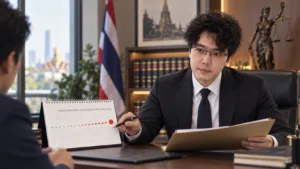
Foreign nationals involved in legal proceedings in Thailand may need to remain in the country to meet investigators, attend hearings, give evidence, or defend a claim. In qualifying cases, Thai Immigration may grant an extension of temporary stay for litigation or court proceedings.
This is often informally called a “litigation visa” or “court case visa.” Technically, however, it is not a separate visa category. It is an extension of the applicant’s existing permission to stay under the Immigration Bureau’s rules.
Being involved in a case does not automatically extend immigration status. The application must be supported by evidence, filed before the current permission expires, and approved by an immigration officer.
Who May Apply for an Extension Based on Legal Proceedings?
Clause 2.26 of Royal Thai Police Order No. 327/2557 covers a foreign national who can prove involvement in litigation or proceedings connected with a case as one of the following:
- an accuser or complainant;
- an injured person or victim;
- an alleged offender or suspect;
- a plaintiff;
- a defendant; or
- a witness.
The rule can therefore assist more than criminal defendants. Depending on the facts and supporting documents, it may also apply to victims, witnesses, and parties to civil or criminal proceedings.
The applicant must also have no circumstances indicating that the legal process is being used merely to prolong their stay in Thailand.
How Long Can the Extension Be Granted?
Immigration considers the necessity arising from the case. If approved, the extension may be granted for no more than 90 days at a time.
The full 90 days is not guaranteed. The officer may consider the next police or court appointment, the current stage of proceedings, the applicant’s immigration record, and the documents provided. If the case continues beyond the approved period, a fresh application may be required before the new expiry date.
The existence of an ongoing case does not create an unlimited right to remain until final judgment. Each extension remains subject to official approval.
Core Documents for a Court Case Visa Extension
The Immigration Bureau’s public guidance identifies the following core documents:
- TM.7 application form for an extension of temporary stay;
- one recent photograph measuring 4 x 6 centimetres;
- the application fee of THB 1,900;
- the applicant’s passport and signed copies of the relevant passport pages; and
- a certificate from the inquiry official handling the case, or another official letter or document confirming the applicant’s involvement in the litigation or related proceedings.
Depending on the case and the responsible immigration office, it is prudent to prepare additional supporting material, including:
- a court appointment notice or record of proceedings;
- the complaint, charge, indictment, or statement of claim, where appropriate;
- documents showing the case number, court, parties, and next appointment;
- bail or temporary-release documents, if applicable;
- proof of the applicant’s current address and the accommodation notification record, where requested;
- a Thai translation of foreign-language documents; and
- a short cover letter explaining why the applicant must remain in Thailand and the period requested.
Requirements can vary with the applicant’s role and the local office’s review. Confirm the current checklist with the immigration office responsible for the applicant’s residence before filing.
Step-by-Step Application Process
1. Check the Current Permission-to-Stay Expiry Date
Do not rely solely on the visa sticker. Check the most recent immigration stamp or other official record showing the date through which the applicant is permitted to stay.
Begin preparing the application well before that date. A pending court case, police investigation, or request for a supporting letter does not stop the immigration clock.
2. Obtain Official Confirmation of the Case
Request a certificate or supporting letter from the inquiry official or obtain an official court document confirming the applicant’s connection with the case. The document should, where possible, identify:
- the applicant and their role in the case;
- the case or reference number;
- the authority handling the matter;
- the current stage of proceedings;
- the next required appointment; and
- why the applicant’s continued presence is necessary.
A lawyer’s letter alone may help explain the application but may not replace the official evidence required by Immigration.
3. Deal With Any Passport Restriction
If the passport has been deposited with a court or authority as part of bail or another order, do not assume it can simply be collected. A lawyer may need to file a request asking for temporary access to the passport for the immigration application.
The request should explain the immigration deadline, the purpose and period of use, and when the passport will be returned. Approval remains a matter for the court or authority holding it.
4. Prepare the TM.7 Package
Complete the form accurately and ensure that names, passport details, entry information, address, case information, and requested period are consistent across all documents. Bring originals for inspection and signed copies where required.
5. Apply at the Responsible Immigration Office
The applicant should contact the immigration checkpoint or office responsible for the area in which they reside. The Immigration Bureau’s guidance states that the foreign national must apply in person.
The officer may request clarification, additional documents, or further confirmation from the police, court, or another government authority. Filing a complete application does not guarantee approval.
6. Check the New Stamp and Calendar the Next Deadline
After approval, check the permitted-until date before leaving the counter. Keep a copy of the application, receipt, supporting letter, and new stamp. Calendar the next immigration deadline separately from every police and court appointment.
Overstay and Blacklisting Risks
Do not allow the permission to stay to expire while waiting for case documents. Involvement in litigation does not excuse overstay automatically.
Overstay is an immigration violation. Official Immigration Bureau guidance states that the usual fine is THB 500 per day, capped at THB 20,000. More importantly, overstay can expose the foreign national to arrest, removal, and a ban on returning to Thailand. The blacklisting period depends on the length of overstay and whether the person leaves voluntarily or is apprehended.
A common and dangerous assumption is that a foreign national can overstay, pay the fine, and then obtain a litigation extension as a matter of course. That is not a safe legal strategy. Once lawful permission has expired, the available procedure depends on the individual’s immigration and case status and requires urgent professional assessment.
Does the Extension Replace 90-Day Reporting?
No. An extension of stay and the address-reporting obligation are separate matters. A foreign national staying in Thailand for more than 90 consecutive days must comply with the applicable 90-day reporting rules unless an exemption applies.
The accommodation notification made by a householder, owner, or hotel and the foreign national’s own 90-day report are also separate requirements.
Can the Applicant Leave Thailand During the Case?
Before travelling, check both immigration status and the case file.
Leaving Thailand without the required re-entry permission may cause the existing permission to stay to end. Separately, bail conditions, a court order, a passport restriction, or an immigration watchlist may prevent departure or require prior approval. A re-entry permit does not override a court order or bail condition.
Frequently Asked Questions
Is every foreign defendant eligible for a litigation extension?
No. Eligibility depends on proof of genuine involvement in the proceedings, the necessity of remaining in Thailand, the absence of conduct suggesting delay, valid immigration status, and the officer’s assessment. The fact that a person is named in a case is not automatic approval.
Can a victim or witness apply?
Potentially, yes. The applicable rule expressly includes an accuser, injured person, and witness, as well as a suspect, plaintiff, and defendant. Official documentation should explain why that person’s continued presence is needed.
Is the extension always 90 days?
No. Ninety days is the maximum for each approval under this ground. Immigration may grant a shorter period based on the needs and timetable of the case.
What if the passport is held by the court?
A request may need to be filed with the court or authority holding the passport. The applicant should not wait until the final days of lawful stay because the request and immigration filing may require time.
Can an overstay be fixed simply by paying a fine?
No. Payment of a fine does not by itself restore lawful immigration status or guarantee an extension. Overstay can also result in arrest, removal, and a re-entry ban. Obtain urgent case-specific advice.
Practical Advice From a Thai Litigation Team
Foreign nationals involved in Thai proceedings should manage the court calendar and immigration calendar as two separate but connected workstreams. The safest approach is to verify the immigration deadline early, obtain official case confirmation, resolve any passport restrictions, and file a complete application before the current permission expires.
Siam Center Law Group assists foreign clients with civil and criminal proceedings, coordination with inquiry officials and courts, immigration-document preparation, passport-access requests, and risk planning where bail, travel restrictions, or overstay issues arise.
This article provides general information as of August 2026 and is not legal advice. Immigration practice, documentary requirements, and the appropriate strategy depend on the applicant’s status, case, location, and current official directions.