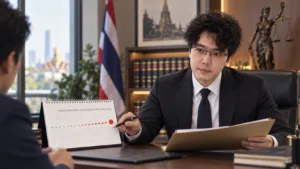
Thailand has tightened the medical controls around cannabis flowers, but it is misleading to say that every person carrying cannabis without a doctor’s certificate automatically commits a Category 5 narcotics offence. The legal result depends on what the substance is, how it was obtained, what conduct is alleged, and which law applies. Cannabis flowers, high-THC extracts, retail licensing and public smoking are governed by different rules.
Fact-checked by Barrister Garn Tuntasatityanond, Barrister-at-Law and licensed Thai lawyer (Thailand Lawyer Licence No. 3417/2553), on 13 October 2026.
What is the short answer for foreigners in Thailand?
As of 13 October 2026, foreigners should treat cannabis flowers as a tightly controlled medical product. A licensed seller is expected to supply cannabis flowers for medical use through the prescribed medical process. That is different from saying that the absence of a prescription automatically converts the flowers into a narcotic drug.
For practical risk management, keep the prescription, receipt, original packaging and the details of the licensed establishment together. Do not smoke in public, do not buy through social media or an unverified seller, and do not carry cannabis across Thailand’s border.
1. What has changed—and what is still only a proposal?
The current controls are built principally on the legal framework for controlled herbs under the Protection and Promotion of Thai Traditional Medicine Wisdom Act B.E. 2542 (1999), available through the Office of the Council of State legal database, together with ministerial notifications and licensing regulations.
The Ministry of Public Health Notification on Controlled Herbs (Cannabis) B.E. 2568 (2025) treats the flower of the cannabis plant as a controlled herb and imposes stricter conditions on research, export, commercial processing and sale. It also restricts online sales, vending-machine sales and sales in certain locations.
The 2026 licensing amendment was published in the Royal Gazette on 30 April 2026. It strengthens the standards for establishments seeking to sell or process cannabis flowers for medical use. These measures are already relevant. By contrast, any separate Cannabis Control Bill remains a proposal until its official text, legislative status and commencement can be confirmed.
2. Buying cannabis flowers: the medical prescription requirement
Under the current controlled-herb system, the lawful medical supply of cannabis flowers uses the official controlled-herb prescription form, commonly referred to as Form Phor Thor 33. The Department of Thai Traditional and Alternative Medicine’s 2026 guidance explains that the prescribed quantity should be limited to what is medically necessary for no more than 30 days.
The prescriber is not limited to a modern medical doctor in every case. Depending on the person’s professional scope and the applicable rules, authorized prescribers may include doctors, dentists, pharmacists, Thai traditional medical practitioners, applied Thai traditional medical practitioners, Chinese medicine practitioners and authorized folk healers.
A general “medical certificate” should not automatically be treated as a substitute for the prescribed controlled-herb form. A foreign visitor should check that the assessment and prescription come from an authorized professional and that the cannabis is supplied through a properly licensed establishment.
3. Cannabis flowers and narcotic extracts are legally different
One of the most common legal mistakes is to treat every cannabis product as though it has the same classification.
- Cannabis flowers: regulated as a controlled herb under the Thai traditional medicine framework.
- Cannabis extracts: may fall within Category 5 narcotics controls depending on their composition, including the applicable THC threshold and any statutory or regulatory exception.
- Foods, beverages, cosmetics and herbal products: may also be subject to product-specific rules administered by the Thai FDA and other authorities.
The often-cited 0.2% THC threshold concerns certain extracts; it should not be used as a blanket test for raw cannabis flowers or every cannabis-containing product. The applicable narcotics framework should be checked against the current Narcotics Code and subordinate legislation in the Office of the Council of State database.
Cannabis-related cases therefore require careful identification of the substance involved and the legal basis of the allegation. A breach of cannabis retail rules should not automatically be described as a narcotics-possession offence. If the allegation concerns a substance classified as a narcotic, see our overview of narcotics possession in Thailand for broader context on possession charges, bail and the evidence relevant to the defence.
4. What do the 2026–2028 licence expiries mean for cannabis shops?
Existing licences do not all expire on one nationwide date. The authorities have explained that licences issued under the former system expire progressively in 2026, 2027 and 2028. An existing operator may generally continue only until its current licence expires and only while complying with the conditions that remain applicable.
If the operator wishes to continue after expiry, it must satisfy the current licensing rules. The 2026 framework identifies several eligible medical-service settings, including licensed clinics, pharmacies, licensed herbal-product shops and qualifying folk-healer premises. Therefore, it is too broad to say that every dispensary must become a “clinic” by 2028. The correct question is whether the particular business can qualify under one of the permitted establishment categories and meet the medical, premises, personnel, record-keeping and security requirements.
Policy statements about moving the entire market toward medical use are important indicators of enforcement direction, but a policy objective is not a substitute for the wording and commencement provisions of the applicable law.
5. Public smoking and international travel
Public smoking
Cannabis smoke or odour may constitute a nuisance under Thailand’s public-health laws where the statutory elements are met. Local officials may investigate and issue an order requiring the nuisance to stop or be remedied. Continued non-compliance can lead to enforcement. The relevant provisions should be checked in the current Public Health Act B.E. 2535 (1992), consolidated by the Office of the Council of State.
This does not mean every instance of smoking in any public place necessarily produces the same charge or penalty. The location, impact on others, local rules, official orders and surrounding evidence all matter. The safest course is not to smoke cannabis in public or anywhere smoke may disturb another person.
Cross-border travel
A domestic purchase or Thai prescription is not permission to carry cannabis through an international airport or across a land border. Import and export are separately regulated activities. Although licensed legal routes may exist for approved operators, ordinary travelers should not take cannabis flowers, extracts, edibles or other cannabis products into or out of Thailand without specific written confirmation from the competent authorities in both countries.
6. What should you do if police question you about cannabis?
- Do not resist the search or destroy evidence. Ask what substance and legal offence are being alleged.
- Keep the product intact. The package, label, receipt and batch details may help establish its source and legal classification.
- Produce the original medical documents. Keep the prescription and the details of the prescriber and licensed seller available.
- Request an interpreter if needed. Do not sign a Thai-language statement that you do not understand.
- Ask for legal advice promptly. The defence may depend on laboratory analysis, the chain of custody, the exact product type, the seller’s licence and the wording of the alleged offence.
Frequently asked questions
Is recreational cannabis already completely illegal again in Thailand?
Thailand has moved decisively toward medical control, particularly for the sale of cannabis flowers. However, it is legally inaccurate to describe an unverified bill or policy proposal as enacted law. The current offence must be identified from the law actually in force and the conduct alleged.
Does carrying cannabis flower without a prescription automatically mean narcotics possession?
No. Cannabis flowers and narcotic cannabis extracts are not legally identical. Lack of the required medical documentation can create serious legal and evidential risk, but the precise charge depends on the product, its composition, its source and the applicable statutory provision.
Can a foreign tourist obtain a Thai cannabis prescription?
Nationality is not the only issue. The person must be assessed within the lawful medical framework by an authorized professional, and any supply should come from a licensed establishment using the required documentation.
Can I bring legally purchased cannabis home from Thailand?
Do not do so without specific written authorization. A lawful domestic purchase does not authorize export from Thailand or import into another country.
Must every cannabis shop become a clinic by 2028?
Not as a universal statement. Existing licences expire on different dates, and continuing operators must qualify under the current rules. Permitted models may include clinics and other specified licensed medical or herbal establishments.
What evidence matters in a cannabis prosecution?
Important evidence may include the seized product, laboratory results, net weight, THC composition where relevant, packaging, receipts, prescription records, licence records, search and seizure documents, and proof linking the accused to possession or sale.
Conclusion
Thailand’s cannabis rules in 2026 are stricter and increasingly medical in character, but legal accuracy still requires separating cannabis flowers from narcotic extracts, current regulations from future bills, and licensing breaches from narcotics offences. Foreigners should use only licensed medical channels, retain complete documentation, avoid public smoking and never carry cannabis across an international border without specific authorization.
This article provides general legal information as of 13 October 2026. It is not legal advice for any individual case. Cannabis regulation may change, and the applicable law should be checked against the product and facts involved.