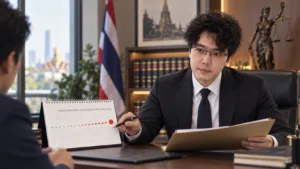
Receiving a police summons in Thailand can be alarming, particularly if you are unfamiliar with the Thai criminal justice system or do not read Thai fluently. The first rule is simple: stay calm, verify the document, and do not ignore it.
A summons is not the same as an arrest warrant. It normally requires you to attend a police station at a specified date and time so that an inquiry official can obtain information, interview you as a witness, or notify you of an allegation as a suspect. Even so, the document should be treated seriously. Failing to attend without a reasonable explanation may increase the risk of further summonses or an application for an arrest warrant.
This guide explains the immediate steps to take, the rights of a suspect during questioning, and the circumstances in which advance planning for temporary release (commonly called bail) may be sensible.
Police Summons vs. Arrest Warrant in Thailand
A police summons is a formal direction to appear before an inquiry official. Depending on the document and the investigation, the recipient may be called as a witness or as a suspect.
An arrest warrant is issued by a court and authorises officers to arrest the person named in it. Under Section 66 of Thailand's Criminal Procedure Code, an arrest warrant may be issued where there is reasonable evidence that a person probably committed an offence carrying a maximum imprisonment term exceeding three years. It may also be issued where there is reasonable evidence of an offence together with grounds to believe that the person may abscond, interfere with evidence, or cause another danger. A person who has no fixed residence or who fails to attend after a summons or appointment without a reasonable excuse may be presumed likely to abscond.
The practical point is that ignoring a summons can make the situation more serious, but an arrest warrant does not arise automatically in every case. The court considers the legal requirements and the circumstances presented.
7 Steps to Take After Receiving a Police Summons
1. Confirm Whether You Are Summoned as a Witness or a Suspect
Read the heading and the stated purpose carefully. A witness is generally asked to provide information about events they saw or know about. A suspect is a person alleged to have committed an offence and has specific procedural rights.
If the wording is unclear, do not guess. Ask the inquiry official or a Thai criminal lawyer to confirm your status before the appointment.
2. Verify That the Summons Is Genuine
Check the police station, case or reference number, name and rank of the inquiry official, official contact details, and the date, time, and place of attendance.
Use independently verified contact details for the police station when possible. Do not transfer money or send sensitive personal information merely because someone has sent a photograph of a supposed summons through a messaging application.
3. Identify the Allegation and the Police Station Handling the Case
Note the alleged offence, the location of the investigation, and the officer responsible for the file. The summons may not contain every detail of the evidence or the complainant's case. A lawyer can contact the officer, clarify the purpose of the appointment, and assess what preparation is appropriate without making unnecessary admissions.
4. Record the Appointment and Preserve the Document
Save a clear copy of every page, the envelope, proof of delivery, and any messages or calls concerning the appointment. Record the exact date, time, and location, and allow sufficient travel time.
Also preserve potentially relevant evidence, including contracts, receipts, messages, emails, photographs, travel records, and the contact details of possible witnesses. Do not alter, delete, fabricate, or coach evidence.
5. Obtain Legal Advice Before Giving a Statement
If you are a suspect, early advice can materially affect the case. Before questioning, a lawyer can help you understand the allegation, organise relevant evidence, identify legal and factual issues, and decide how to exercise your right to give a statement or remain silent.
Do not sign a statement, acknowledgement, settlement, consent, or other document you do not fully understand. If you require an interpreter, raise that need before substantive questioning begins.
6. If You Cannot Attend, Contact the Officer Promptly and Make a Written Request
Do not simply fail to appear. Contact the inquiry official as soon as the conflict becomes known and submit a written request to postpone the appointment. State the reason, propose a new date, and attach supporting evidence where available—for example, a medical certificate or evidence of an unavoidable emergency.
Whether a postponement is accepted depends on the circumstances. A general statement that you are busy may not be sufficient. Keep proof that the request was sent and any response received.
7. Assess Arrest and Temporary-Release Risk Before Attending
Attending voluntarily is generally relevant to whether there is a risk of absconding, but it does not guarantee that you cannot be arrested, taken to court for a detention order, or required to seek temporary release.
The risk should be assessed case by case, taking into account the offence, maximum penalty, any existing warrant, the evidence, the person's residence and ties to Thailand, alleged conduct involving witnesses or evidence, and the inquiry official's intended procedure. Where the risk is material, a lawyer can coordinate in advance and advise whether documents, a guarantor, security, or another temporary-release arrangement should be prepared.
The three-year threshold in Section 66 concerns one statutory ground for issuing an arrest warrant. It should not be treated as a universal rule that cases below that threshold never require bail or that cases above it always do.
Rights of a Suspect During Police Questioning
Under Sections 134, 134/1, 134/3, and 134/4 of the Criminal Procedure Code, important safeguards include:
- the right to be informed of the facts relating to the alleged conduct and the charge;
- the right to a prompt, continuous, and fair investigation;
- the opportunity to answer the allegation and present facts supporting the defence;
- the right to give a statement or remain silent, with notice that any statement may be used as evidence;
- the right to have a lawyer or a trusted person attend the questioning; and
- in qualifying cases, the right to ask for a state-provided lawyer in accordance with the law.
These rights are meaningful only when exercised carefully. What a suspect says at the first interview can affect the direction of the investigation and later proceedings.
What to Bring to the Police Station
Unless your lawyer advises otherwise, prepare:
- the original summons and a copy;
- passport or Thai identification document;
- evidence of your current address and stable ties, if relevant;
- an interpreter if needed and permitted arrangements have been confirmed;
- your lawyer's contact details and appointment documents;
- an organised copy of relevant evidence approved for presentation; and
- any temporary-release documents or security recommended after a case-specific assessment.
Avoid bringing original evidence that could be lost or retained unless it is required. Keep an inventory and copies of anything delivered to the authorities.
Frequently Asked Questions
Do I have to hire a lawyer to attend with me?
Not every recipient is legally required to retain private counsel. However, a suspect has the right to have a lawyer or trusted person attend questioning, and legal advice is especially important where the allegation carries imprisonment, the facts are disputed, documents are complex, or there may be arrest or detention risk.
Can I ask to postpone the appointment?
You may request a postponement, but approval is not automatic. Contact the inquiry official promptly, make the request in writing, explain the reasonable necessity, provide supporting documents, and propose a specific alternative date. Retain proof of the request and response.
Will I be jailed immediately if I attend the summons?
Not necessarily, but voluntary attendance is not an absolute guarantee of release. Depending on the case, the inquiry official may notify the allegation and question you, may release you, or may take steps connected with arrest, detention, or temporary release. Obtain a case-specific assessment before attending if the allegation is serious or your status is unclear.
What happens if I ignore the summons?
Failure to attend without a reasonable excuse may be treated as indicating a risk of absconding and may support an application for an arrest warrant under Section 66. The correct response is to verify the summons, obtain advice, attend as required, or promptly request a postponement with evidence.
Speak to a Thai Criminal Lawyer Before the Appointment
Early preparation can reduce avoidable risk. Siam Center Law Group assists Thai and foreign clients with police-summons verification, pre-interview advice, attendance during questioning, evidence planning, and temporary-release preparation where required.
This article provides general information about Thai law and is not legal advice for any individual case. The correct strategy depends on the summons, alleged offence, evidence, and the investigating authority's intended procedure.