Reviewed and updated: 4 October 2026
A marriage-based extension of stay in Thailand does not prevent immigration authorities from revoking permission to remain before its expiry. Where serious facts indicate that a foreign national may threaten public safety or be linked to transnational crime, the legal issue is not necessarily overstay. It may instead concern revocation under Section 36 of the Immigration Act B.E. 2522 (1979).
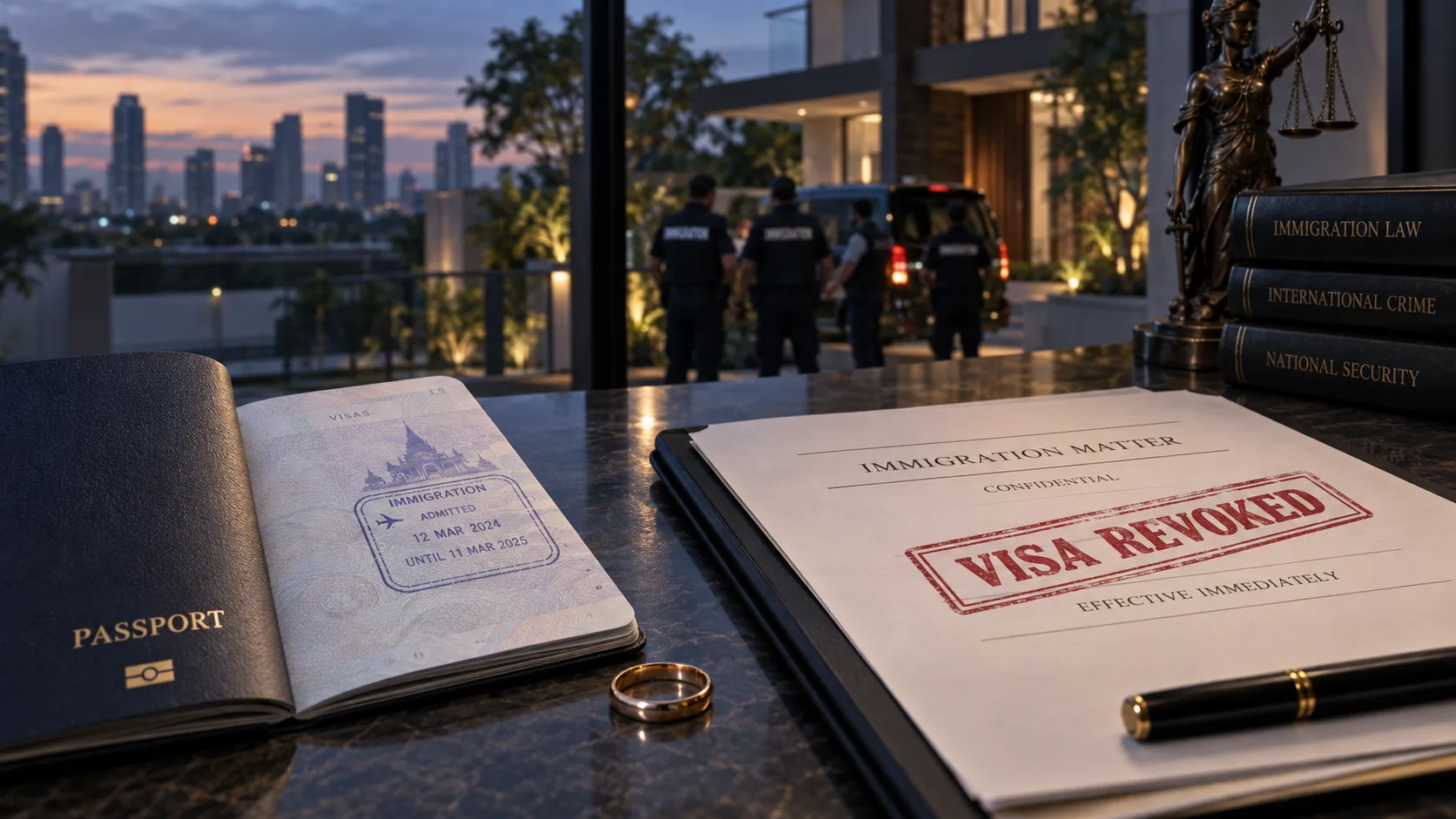
A recent operation involving a Chinese national arrested at a luxury residence in Bangkok illustrates the distinction. News reports state that the suspect still held a valid marriage-based extension when immigration authorities revoked his permission to stay after receiving information from Chinese authorities concerning an alleged transnational narcotics case. The allegations have not been finally determined by a court, and the individual remains entitled to the presumption of innocence.
A valid marriage-based extension can still be revoked
A foreign national may be lawfully present on the date of arrest and yet lose the right to remain through a later revocation decision. This differs from overstay, which occurs when the authorised period has already expired.
Under Section 36 of the Immigration Act, the Director-General of the Immigration Bureau or the Immigration Commission may revoke permission previously granted to a foreign national to remain temporarily in Thailand where circumstances warrant revocation. The section does not give this power generally to every immigration officer.
In assessing whether revocation is warranted, Section 12 may also be relevant. Among other matters, Section 12 addresses a person whose behaviour indicates a possible danger to the public or who is subject to an arrest warrant issued by a competent foreign authority, as well as a person reasonably believed to have entered Thailand to engage in narcotics trafficking or other activities contrary to public order or good morals.
Official legal source: Office of the Council of State – Thai law database. Search for “Immigration Act B.E. 2522” and review Sections 12 and 36.
Case study: the Bangkok luxury-residence operation
According to reports published on 2 October 2026, Thailand’s Immigration Bureau and the Office of the Narcotics Control Board jointly searched a residence in the Bangkok Kreetha area and detained a Chinese national identified in the reports as “Mr Wang.” Authorities alleged that he was wanted in China in connection with transnational narcotics activity. Preliminary checks reportedly identified more than THB 50 million in account transactions over several months.
The reports state that he entered Thailand through the Satun immigration checkpoint on 22 June 2026 and later obtained an extension based on marriage to a Thai national, valid until 8 October 2026. Immigration authorities reportedly revoked his permission to stay on public-safety and security grounds.
News sources: The Nation, 2 October 2026 and TV5HD, 2 October 2026. The factual account above is based on those reports and should not be treated as a judicial finding.
The 48-hour appeal period: who may appeal?
The appeal route depends on who made the revocation order:
- Order made by the Director-General: the foreign national may appeal to the Immigration Commission. The appeal must be lodged with a competent official within 48 hours from the time the person became aware of the Director-General’s order, using the prescribed form and paying the prescribed fee.
- Order made by the Immigration Commission: Section 36 states that the Commission’s order is final under that statutory appeal process.
The deadline is measured in hours, not ordinary working days. Counsel should immediately obtain the written order and evidence of the exact date and time of notification. Section 36 does not itself state that filing the appeal automatically suspends removal. It is therefore unsafe to assume that an appeal alone prevents further enforcement; the available route for interim protection must be considered urgently from the actual order and procedural posture.
Removal is not the same as extradition
| Procedure | Purpose | Main legal framework |
|---|---|---|
| Removal from Thailand | Removes a foreign national who may not lawfully remain in the Kingdom | Immigration Act, including Section 54 where applicable |
| Extradition | Surrenders a person to a requesting state for prosecution or enforcement of a criminal judgment | Extradition Act B.E. 2551 (2008), any applicable treaty, and court proceedings |
Public statements that authorities are “coordinating a return” do not by themselves establish which legal procedure will ultimately be used. Lawyers should confirm whether the matter involves administrative removal, a formal extradition request, a Thai criminal case, or overlapping proceedings.
Official legal sources: Office of the Council of State – Thai law database and the Extradition Act B.E. 2551 (2008).
Non-refoulement must be assessed individually
Section 13 of the Prevention and Suppression of Torture and Enforced Disappearance Act B.E. 2565 (2022) prohibits a government authority or public official from expelling, deporting, or extraditing a person where substantial grounds exist for believing that the person would face a risk of torture, cruel, inhuman or degrading treatment, or enforced disappearance.
This protection is not established merely by asserting fear. The claimed risk must be supported by specific and credible evidence relating to the person, the receiving state, and the anticipated treatment. It should nevertheless be investigated before removal or extradition is carried out.
Official legal source: Office of the Council of State – Thai law database. Search for the Prevention and Suppression of Torture and Enforced Disappearance Act B.E. 2565 and review Section 13.
Four document sets counsel should obtain immediately
- Passport and latest permission-to-stay stamp: confirm the legal basis, conditions, and expiry date of the existing permission.
- Revocation order and proof of notification: identify the decision-maker, legal grounds, and exact time the order became known so that the 48-hour deadline can be calculated correctly.
- Search warrant, arrest record, and detention documents: identify the authority relied upon for the search, arrest, transfer, and continuing custody.
- Removal, extradition, and foreign-warrant documents: determine whether authorities are pursuing immigration removal, extradition, a Thai criminal proceeding, or more than one process.
Frequently asked questions
Can a foreign national with a Thai spouse have a marriage-based extension revoked?
Yes. Marriage to a Thai national and a valid permission-to-stay stamp do not prevent revocation under Section 36 where circumstances warrant it. The facts and the authority making the order must be examined.
Does every revocation order carry a 48-hour appeal?
No. Section 36 provides an appeal to the Immigration Commission when the Director-General made the revocation order. A revocation order made by the Immigration Commission is final under that statutory appeal process.
Does filing an appeal automatically stop removal?
Section 36 does not expressly provide an automatic suspension. Counsel should not rely on the appeal alone and must urgently assess the available interim protection in light of the written order and the actual enforcement process.
Is deportation the same as extradition?
No. Immigration removal concerns the right to remain in Thailand. Extradition is a separate judicial and governmental process for surrendering a person to another state for criminal proceedings or punishment.
Watch the video
Author: Barrister Garn T.
Thailand Lawyer Licence No. 3417/2553
Siam Center Law Group
Prepared and legally reviewed: 4 October 2026
This article provides general information on Thai law. Immigration, removal, extradition, and non-refoulement issues depend on the written orders, evidence, treaties, and procedural posture of each case. Legal advice should be obtained immediately where a statutory deadline is running.