Fact-checked by Garn Tuntasatityanond, Barrister-at-Law and licensed Thai lawyer (Thailand Lawyer Licence No. 3417/2553), on 5 October 2026.
Bringing cash into Thailand is generally not subject to a fixed ceiling. However, once Thai currency, foreign currency, or specified negotiable instruments exceed the applicable declaration threshold, the traveller must declare them to Thai Customs. The key distinction is therefore between how much may be brought in and when a declaration becomes compulsory.
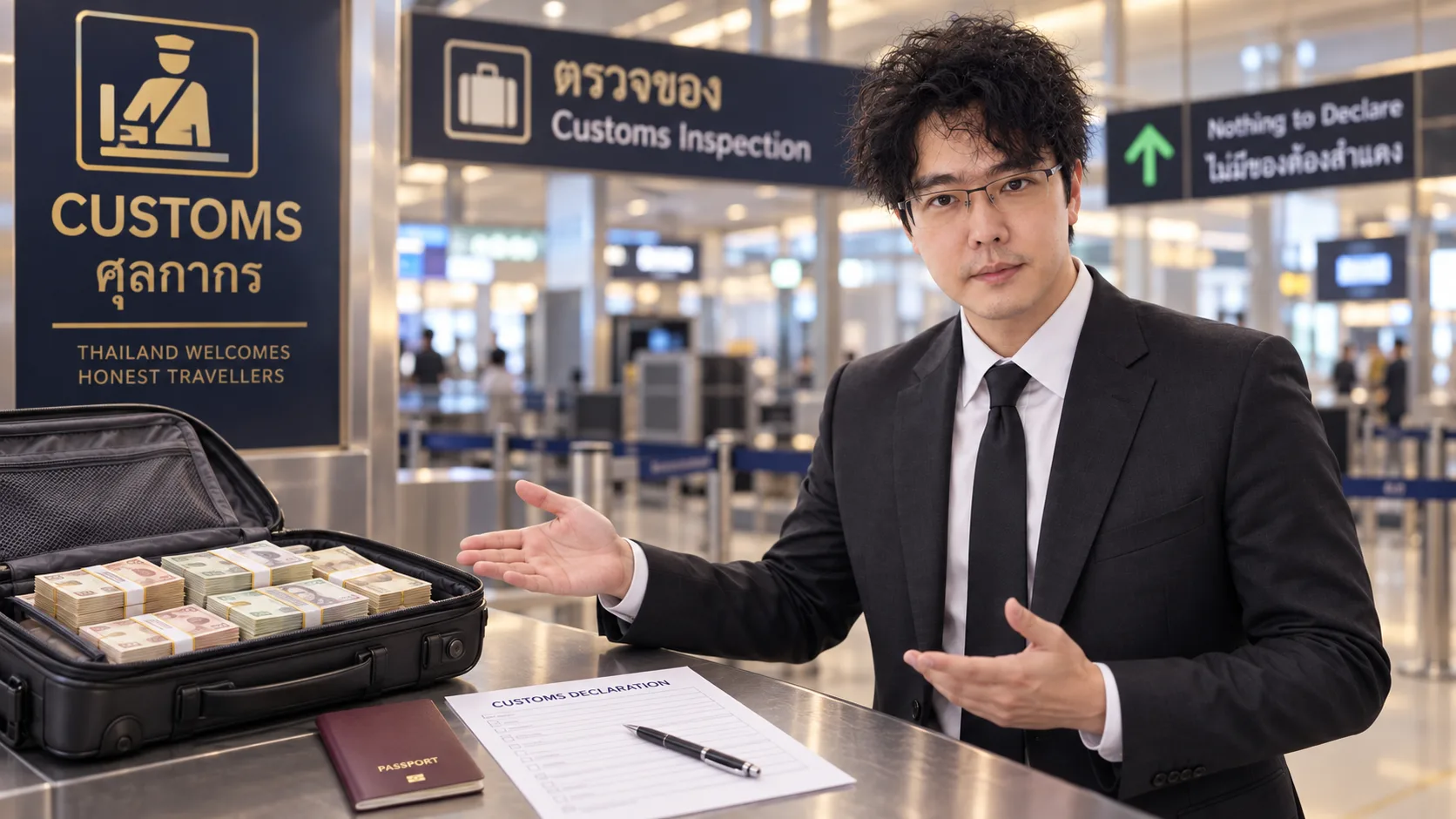
This distinction became especially relevant after news reports stated that two foreign passengers arriving at Suvarnabhumi Airport from Jakarta were arrested on 30 September 2026 after officers allegedly found US-dollar banknotes worth more than THB 56 million concealed in their luggage. The report concerns allegations, not a final court judgment, and it does not establish that the passengers committed money laundering.
Quick answer: when must cash be declared in Thailand?
According to the Thai Customs Department’s public guide, last updated in February 2025, a declaration is required in the following situations:
- Foreign currency: foreign-currency banknotes or specified negotiable instruments denominated in foreign currency with a total value exceeding USD 15,000 or its equivalent.
- Thai currency: Thai-baht banknotes or specified negotiable instruments denominated in baht with a combined value exceeding THB 450,000.
- Combined holdings: Thai baht, foreign currency, and specified negotiable instruments with an aggregate value exceeding THB 450,000.
These figures are declaration thresholds, not maximum amounts. A traveller may bring a larger amount into Thailand, but must correctly declare it and comply with any other applicable legal requirements.
Official guidance: Thai Customs public guide on bringing currency and negotiable instruments into or out of Thailand and the Bank of Thailand’s foreign-exchange rules.
The Suvarnabhumi cash case: what has actually been reported?
The Nation reported on 4 October 2026 that Customs officers arrested two foreign passengers at Suvarnabhumi Airport on 30 September 2026. The passengers had arrived from Jakarta, Indonesia, and officers reportedly discovered US-dollar banknotes worth more than THB 56 million concealed in their luggage.
The Customs Department reportedly alleged breaches of Thailand’s exchange-control and customs laws. The report did not identify the passengers’ nationalities, state the exact amount in US dollars, specify every criminal charge or statutory section, or report a final outcome. It also referred to a wider policy of preventing cross-border cash smuggling and potential money laundering; that policy context is not proof that these passengers committed a money-laundering offence.
News source: The Nation, 4 October 2026.
No import ceiling does not mean no declaration duty
The Bank of Thailand explains that Thai-baht and foreign-currency banknotes may be brought into Thailand without a fixed quantitative limit. That principle does not cancel the separate obligation to declare amounts exceeding the prescribed thresholds.
This produces two different legal questions:
- May the money be brought into Thailand? In principle, currency may be brought in without a fixed maximum.
- Must the traveller report it? Yes, where the amount or aggregate value crosses the applicable threshold.
A lawful source of funds may help explain ownership and purpose, but it does not replace the declaration required at the border. Likewise, declaring the cash does not by itself prove that the money is lawful; officers may still ask questions or investigate suspicious circumstances.
Declaration thresholds at a glance
| Property carried | When declaration is required | Important qualification |
|---|---|---|
| Foreign-currency banknotes or specified negotiable instruments in foreign currency | More than USD 15,000 or equivalent | Calculate the total across relevant foreign currencies; do not rely on a fixed baht conversion copied from an old article. |
| Thai-baht banknotes or specified negotiable instruments denominated in baht | More than THB 450,000 | This is a declaration threshold for bringing money into or out of Thailand, not an import ceiling. |
| Thai baht, foreign currency, and specified negotiable instruments combined | Aggregate value of more than THB 450,000 | The combined-value rule means that looking at each currency separately may produce the wrong answer. |
Not every cheque is treated identically
The Customs guide refers to negotiable instruments that do not identify a payee and do not contain a restriction on transfer. The category should not be described as covering every cheque, draft, or financial document without examining its form and transferability.
Travellers carrying bearer instruments or unusual payment documents should obtain advice before travel and present the documents to Customs rather than assuming that only physical banknotes count.
What laws may become relevant?
The legal framework includes the Exchange Control Act B.E. 2485 (1942), as amended; the 2016 ministerial regulation concerning the movement of Thai currency, foreign currency, and negotiable instruments; related Ministry of Finance notifications; and the Customs Act B.E. 2560 (2017).
Official statutory sources: search the relevant instruments in the Office of the Council of State’s Thai law database. The Customs Act B.E. 2560 (2017) is also available directly from that database.
Section 244 of the Customs Act provides serious penalties where a person brings goods into or sends them out of Thailand while evading an applicable restriction or prohibition. If the proven facts fall within that section, the maximum penalty is imprisonment for up to 10 years, a fine of up to THB 500,000, or both, and the court may order forfeiture.
That does not mean Section 244 automatically applies whenever a traveller fails to declare cash, nor does the news report confirm that the two passengers were charged under that provision. The precise offence depends on the property, conduct, applicable exchange-control rule, Customs allegation, and evidence. Concealment, false information, ownership, knowledge, and purpose may materially affect the legal analysis.
Official explanation: Thai Customs explanation of Section 244.
How to declare cash at a Thai airport or border checkpoint
- Calculate the total before travel. Include every relevant currency and specified negotiable instrument carried by the traveller.
- Approach Customs before leaving the controlled area. Do not wait until officers discover the cash during a search.
- Complete the prescribed declaration form. An online form may assist preparation, but the Customs guide states that the declaration must still be made in person to an officer.
- Present the passport and money for verification. The officer will examine the form and count the currency in the traveller’s presence.
- Keep the endorsed copy. After verification, the officer signs and stamps the form and returns a copy to the traveller. The stated procedure carries no fee.
Documents worth preparing
The official procedure identifies the passport and prescribed declaration form as the basic documents. Depending on the circumstances, it is also prudent to carry evidence showing the source, ownership, and intended use of the money, such as:
- bank withdrawal or exchange records;
- sale, loan, investment, or settlement agreements;
- corporate resolutions or accounting records where company funds are involved;
- documents identifying the beneficial owner; and
- a written explanation of the commercial or personal purpose.
These additional documents are practical evidence, not necessarily mandatory attachments in every routine declaration. Their importance increases where the sum is unusually large, the traveller carries money for another person, or the circumstances may create questions about concealment or financial crime.
Frequently asked questions
Is USD 15,000 the maximum cash I may bring into Thailand?
No. It is a declaration threshold for foreign currency, not a general maximum. Larger sums may be brought in, but they must be declared and may be examined by Customs.
If my cash came from a lawful source, do I still have to declare it?
Yes, if the applicable threshold is exceeded. Lawful origin and border declaration are separate issues. Evidence of lawful origin does not replace the required declaration.
Can I divide the money between different currencies to stay below USD 15,000?
Do not assess each currency in isolation. Customs rules include aggregate-value tests, including a combined threshold expressed in Thai baht. Calculate the entire amount and seek clarification before travelling if the result is close to a threshold.
Does failure to declare automatically mean money laundering?
No. A failure to declare may create exchange-control or customs exposure, but money laundering has separate legal elements that must be proved. The amount of cash, concealment, source of funds, ownership, and intended use may all be investigated.
What should I do if Customs has detained me or seized the money?
Request copies of the arrest or seizure record, declaration documents, inventory of the currency, and the written allegation. Do not sign a statement you do not understand. Obtain an interpreter and Thai legal advice promptly, particularly before giving a detailed explanation about ownership or source of funds.
Author and legal reviewer: Garn Tuntasatityanond, Barrister-at-Law and licensed Thai lawyer (Thailand Lawyer Licence No. 3417/2553), Siam Center Law Group.
This article provides general information on Thai law as reviewed on 5 October 2026. Currency controls and enforcement practice may change. The applicable law and defence strategy depend on the exact currency, documents, conduct, statements, and official charge in each case.