Author name: Barrister Garn Tuntasatityanond

Thai barrister and licensed lawyer (Thailand Lawyer Licence No. 3417/2553 / ใบอนุญาตให้เป็นทนายความ No. 3417/2553), Siam Center Law Group.

Editorial illustration of Barrister Garn Tuntasatityanond at a consultation desk beside the headline Verify Your Thai Lawyer, with a fact-check statement dated 12 November 2026.

How to Verify a Licensed Lawyer in Thailand Before Hiring

Before hiring a lawyer in Thailand, check the actual individual’s registration through the Lawyers Council’s official search service, match the result to their identity, and clarify any uncertainty directly with the Council. A register entry is a starting point: the public search does not currently provide a complete online check of disciplinary status.

How to Verify a Licensed Lawyer in Thailand Before Hiring Read More »

Editorial illustration of Barrister Garn Tuntasatityanond reviewing company papers beside a model house and symbolic prison bars, with the headline Jailed for a Nominee Company and a fact-check statement dated 12 November 2026.

Jailed for a Nominee Company: A Wake-Up Call from Hua Hin

A suspended sentence is not something foreign owners can count on in a Thai nominee case. Reporting from Hua Hin describes defendants being sent to prison after six-month sentences without suspension. The practical warning is to review the real ownership and funding of a company before a complaint, investigation or court hearing.

Jailed for a Nominee Company: A Wake-Up Call from Hua Hin Read More »

Editorial illustration of Barrister Garn Tuntasatityanond discussing immigration detention after prison release in Thailand, with the headline Released from Prison, Still in IDC and fact-check credentials dated 11 November 2026.

Released from Prison, Still Detained in Thailand: IDC Bail and Return Risks

Finishing a prison sentence in Thailand does not automatically end separate immigration proceedings. A foreign national without permission to stay may face immigration detention or an approved conditional-residence arrangement pending removal. Release, the necessity of continued detention and whether return would expose the person to prohibited harm must each be examined separately.

Released from Prison, Still Detained in Thailand: IDC Bail and Return Risks Read More »

Barrister Garn Tuntasatityanond beside the headline Home Intruder in Thailand, with a self-defence legal limits message and fact-check credentials dated 10 November 2026.

Can You Use Force Against a Home Intruder in Thailand?

Thai self-defence law can justify force against a home intruder when it is necessary to protect a right from imminent unlawful danger and is reasonable in the circumstances. Night-time entry, a single shot or ownership of the house does not decide the issue. Mistaken belief, excessive force and retaliation require separate analysis.

Can You Use Force Against a Home Intruder in Thailand? Read More »

Barrister Garn Tuntasatityanond reviewing company records for Non-B renewal in Thailand, with ownership, payroll and office checks and a Fact-checked statement dated 9 November 2026.

Non-B Renewal in Thailand: Is Your Company Ready?

For a Non-B renewal in Thailand, a company’s shareholder list is only part of the evidence. Immigration examines the applicable employment route, paid-up capital, accounts, staff and workplace. DBD has separate investment-verification rules. Prepare records that explain the real business and money movements; Thai-majority ownership alone does not establish eligibility.

Non-B Renewal in Thailand: Is Your Company Ready? Read More »

Barrister Garn Tuntasatityanond beside a locked phone, explaining Thai police phone searches and court orders; fact-checked on 8 November 2026.

Can Thai Police Search Your Phone Without a Court Order?

Fact-checked by Barrister Garn Tuntasatityanond, Barrister-at-Law and licensed Thai lawyer (Thailand Lawyer Licence No. 3417/2553), on 8 November 2026. Key takeaways A police officer asks you to unlock your phone. Must you do it? Imagine an officer approaches you in public and says, “Unlock your phone. I want to see your chats.” That statement alone

Can Thai Police Search Your Phone Without a Court Order? Read More »

Barrister Garn Tuntasatityanond in an illustrative legal consultation beside the words 5,732 Days Overstay and Nearly 16 Years, with fact-check credentials dated 8 November 2026.

5,732 Days of Overstay in Thailand: Nearly 16 Years Beyond Permission—and More Than a Fine

A reported 5,732-day overstay in Thailand means nearly 16 years beyond permission. The THB 20,000 fine cap does not cap every legal consequence: criminal proceedings, removal and a ten-year re-entry ban may follow. Separate criminal allegations and other grounds for refusing entry require their own assessment; a lifetime ban should not be assumed.

5,732 Days of Overstay in Thailand: Nearly 16 Years Beyond Permission—and More Than a Fine Read More »

Barrister Garn Tuntasatityanond explaining one-day overstay in Thailand, with the Fact-checked statement dated 6 November 2026.

One-Day Overstay in Thailand: A Fine or a Five-Year Re-entry Ban?

One day of overstay in Thailand can mean more than a fine. Voluntary surrender within 90 days does not trigger the surrender-based ban in Order 1/2558. Arrest and prosecution for overstay of one year or less can trigger a five-year re-entry ban, subject to the order’s exceptions.

One-Day Overstay in Thailand: A Fine or a Five-Year Re-entry Ban? Read More »

Barrister Garn Tuntasatityanond explaining arrest rights in an illustrative legal consultation, with a fact-check statement dated 4 November 2026.

Arrested in Thailand? Your Rights to Silence, an Interpreter, a Lawyer and Bail

If you are arrested in Thailand, you have rights concerning statements, interpretation, private legal consultation and provisional release. You can request release during custody without waiting 48 hours. State-provided lawyers depend on statutory conditions, while bail does not always require cash security. The stage of proceedings determines how each safeguard applies.

Arrested in Thailand? Your Rights to Silence, an Interpreter, a Lawyer and Bail Read More »

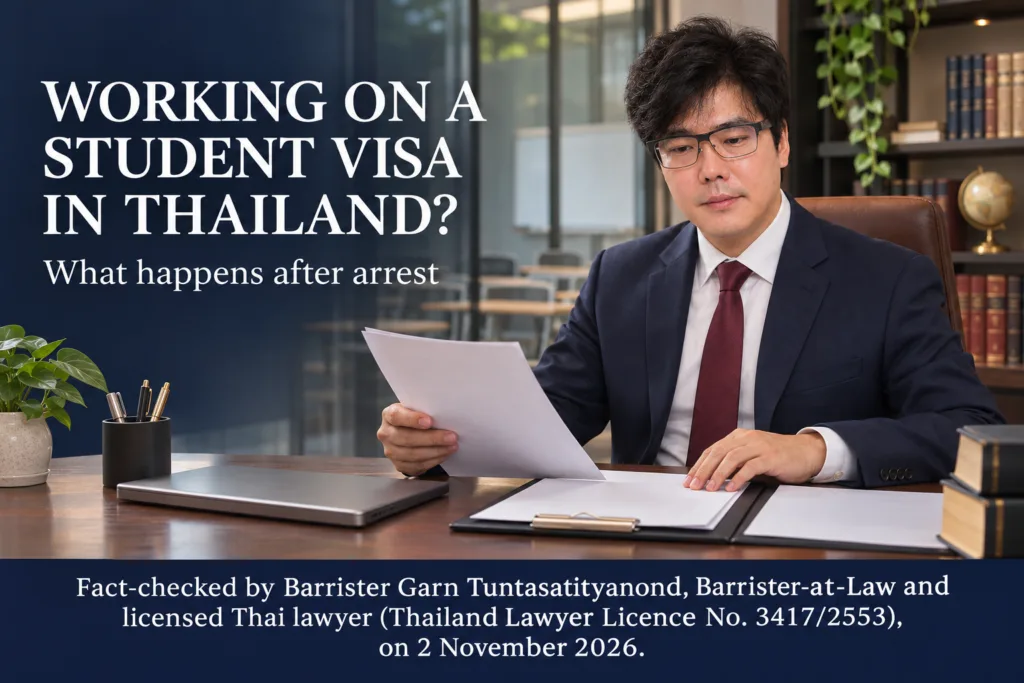
Barrister Garn Tuntasatityanond reviewing teaching and immigration paperwork in an illustrative office scene, with fact-check credentials dated 2 November 2026.

Working on a Student Visa in Thailand? What Happens After Arrest

A Thai student visa does not itself authorise employment. Working without permission can lead to a fine and removal, even while permission to stay remains valid. The procedure, custody, immigration orders and future work-permit eligibility must be assessed separately. Employers face their own penalties; neither automatic detention nor a fixed re-entry ban should be assumed.

Working on a Student Visa in Thailand? What Happens After Arrest Read More »

Scroll to Top
Siam Center Law group law firm in Bangkok Thailand best lawyer in bangkok
Privacy Overview

This website uses cookies so that we can provide you with the best user experience possible. Cookie information is stored in your browser and performs functions such as recognising you when you return to our website and helping our team to understand which sections of the website you find most interesting and useful.