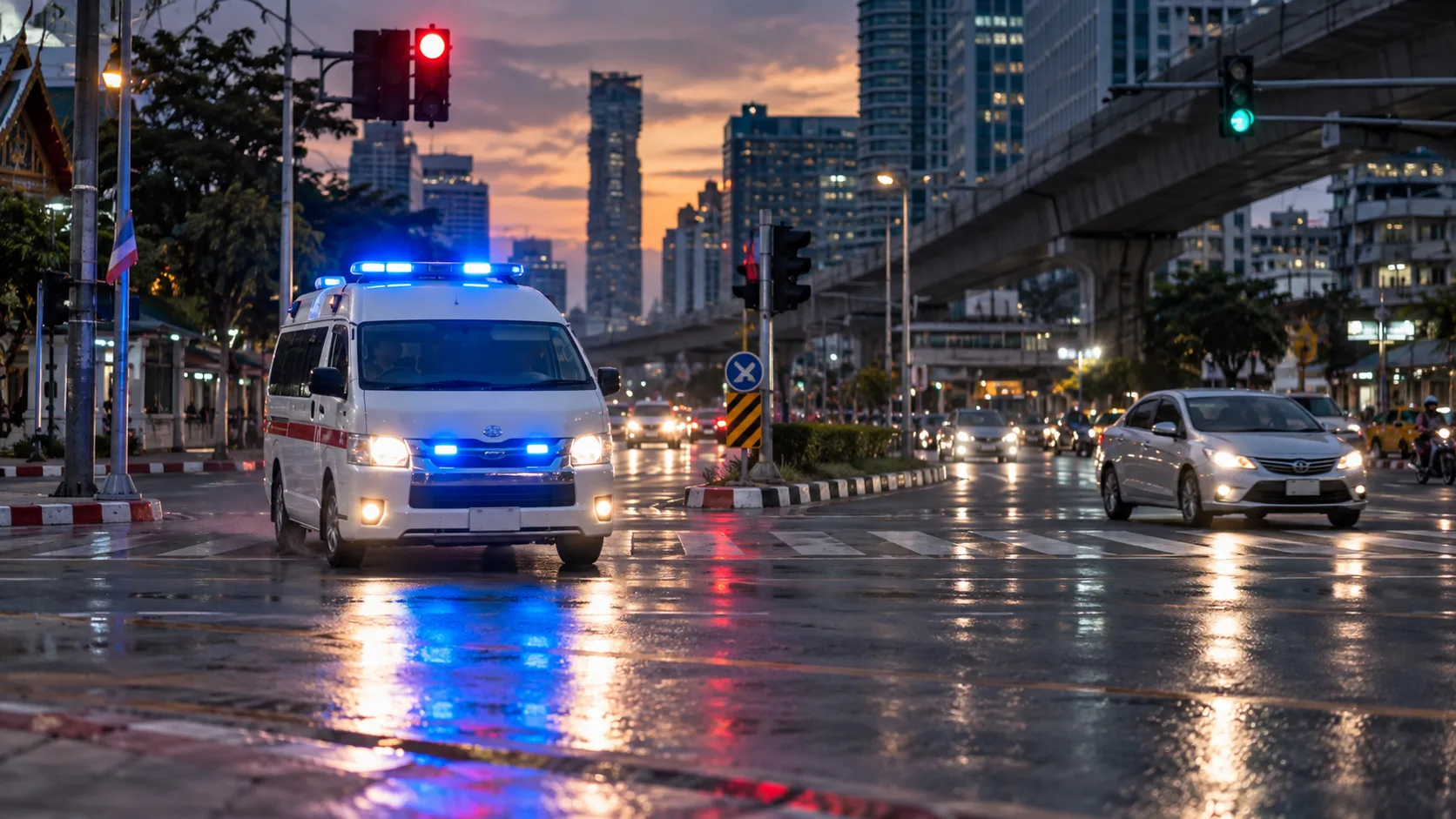
An ambulance or other authorised emergency vehicle may pass a red traffic signal in Thailand while performing an emergency duty, but it does not have an unrestricted right of way. The driver must slow down as appropriate and exercise reasonable care. If a collision occurs, liability depends on the conduct of every driver, the visibility and audibility of the emergency signals, the speed and position of the vehicles, and—where criminal proceedings are brought—the way the alleged negligence is described in the charge.
The leading authority is Supreme Court Judgment No. 8155/2555 (2012). The decision is sometimes cited under the wrong number. It does not establish that an ambulance driver can never be negligent. Rather, the Supreme Court upheld an acquittal because the prosecution alleged only that the emergency vehicle negligently ran a red light, even though Section 75(4) legally permitted it to pass the signal. Other possible negligent conduct had not been pleaded.
The short answer
- An authorised emergency vehicle performing its duty may pass a red light under Section 75(4) of the Land Traffic Act.
- It must reduce speed as appropriate and the driver must exercise reasonable care.
- Other road users who see the flashing light or hear the siren must allow the emergency vehicle to pass under Section 76.
- A green light does not relieve another driver from the duty to observe the road and yield to a properly signalled emergency vehicle.
- Neither vehicle is automatically liable. The evidence may establish negligence by the emergency driver, the other driver, or both.
What rights does an emergency vehicle have under Section 75?
Section 75 of the Land Traffic Act B.E. 2522 (1979) grants specified privileges while the driver of an emergency vehicle is performing an official duty. These include using authorised flashing lights or sirens, stopping where parking is otherwise prohibited, exceeding the applicable speed limit, passing a traffic signal or sign that requires vehicles to stop, and departing from certain lane, direction, or turning rules.
The red-light privilege is expressly qualified. Under Section 75(4), the driver must reduce the vehicle’s speed as appropriate when passing a stop signal. The concluding paragraph of Section 75 also requires reasonable care in exercising every emergency privilege.
The privilege therefore removes the automatic traffic violation of passing the red signal; it does not remove the general duty to drive safely. Entering a blind intersection at excessive speed, failing to check cross traffic, or using emergency privileges without actually performing an authorised emergency duty may still support a finding of negligence.
What must other road users do under Section 76?
When a road user sees an emergency vehicle performing its duty with a flashing light, or hears its siren or another authorised signal, Section 76 requires the emergency vehicle to be allowed to pass first.
A driver must stop or park close to the left edge of the road, or close to the bus lane where the leftmost lane is reserved for buses. The driver must not stop in the intersection itself. The manoeuvre must be made as quickly as reasonably possible and with appropriate care.
This duty applies even when the other vehicle has a green signal. However, criminal or civil liability still requires proof that the driver could see or hear the emergency vehicle in time and could safely yield. A siren that was not operating, an obstructed view, an extremely sudden entry, or evidence that yielding would itself have created immediate danger may change the analysis.
Supreme Court Judgment No. 8155/2555: why the ambulance driver was acquitted
In Supreme Court Judgment No. 8155/2555, the defendant drove a government hospital van to transfer a patient to another hospital. While turning through an intersection, the van collided with a motorcycle travelling straight through the junction. The motorcyclist was injured and later died.
The prosecution alleged negligent driving causing death under Section 291 of the Penal Code and offences under the Land Traffic Act. The pleaded negligence was that the defendant entered the intersection against a red light instead of waiting for a green light.
The evidence established that the hospital vehicle was an emergency vehicle, that the defendant had been instructed to transfer a patient, and that the emergency warning light was in use. Section 75(4) therefore entitled the defendant to pass the red signal, subject to slowing down and exercising reasonable care.
Evidence at trial may have suggested that the defendant failed to slow sufficiently or exercise appropriate care. However, those were not the negligent acts alleged in the charge. Section 192 paragraph one of the Criminal Procedure Code prevents a court from convicting a defendant for conduct materially different from the conduct charged. The Supreme Court consequently upheld the acquittal.
Key procedural lesson: The acquittal resulted from the scope of the charge. The judgment should not be read as a finding that passing a red light in an emergency vehicle can never be negligent.
Who may be liable after an ambulance collision?
| Evidence and conduct | Possible legal significance |
|---|---|
| Authorised emergency duty; flashing light or siren operating; speed reduced; intersection checked | Supports lawful use of Section 75 privileges and reasonable care by the emergency driver |
| Emergency vehicle enters at excessive speed or without checking visible cross traffic | May support criminal and civil negligence despite the Section 75 privilege |
| Other driver sees or hears the emergency signal but accelerates, turns across its path, or fails to yield | May breach Section 76 and support a finding of negligence |
| Other driver has a green light but could not reasonably see or hear the emergency vehicle | The green light is relevant but not conclusive; visibility, audibility, reaction time, and road layout must be examined |
| Both drivers could have avoided the collision but each failed to take reasonable precautions | Both may be negligent; civil damages may be apportioned according to their contribution to the loss |
A practical rescue-work example
In a matter observed through rescue-foundation work, an emergency vehicle using warning signals entered an intersection during an urgent response and a vehicle from the opposing direction turned across its path. Serious injuries followed. The dispute illustrates why a green signal alone does not decide liability: the court must consider whether the other driver perceived or should have perceived the emergency signals and whether the emergency driver approached the intersection with appropriate care.
This practitioner example should be distinguished from a published Supreme Court precedent. Without a publicly identifiable judgment and complete case record, a particular prison sentence or damages award should not be presented as a general legal rule. Outcomes depend on the charge, injuries, evidence, degree of negligence, mitigation, insurance, and civil claims in the individual case.
Criminal and civil consequences
If negligent driving causes death, Section 291 of the Penal Code may apply. If it causes grievous bodily harm, Section 300 may apply. Section 43(4) of the Land Traffic Act also prohibits driving negligently or in a manner that may endanger persons or property.
Civil liability may arise under Section 420 of the Civil and Commercial Code. Where the injured person also contributed to the accident, Sections 442 and 223 allow the court to take comparative fault into account when assessing damages. Employer, vehicle-owner, insurer, compulsory motor insurance, and government-agency liability may also require separate analysis.
Evidence that should be preserved immediately
- dash-camera, CCTV, traffic-camera, and mobile-phone recordings;
- the original audio track showing whether and when the siren could be heard;
- GPS, dispatch, radio, hospital-transfer, or rescue-operation records proving the emergency duty;
- data or expert evidence concerning speed, braking, impact position, and reaction time;
- the traffic-light sequence and intersection layout;
- witness accounts identifying when the flashing lights or siren became perceptible;
- photographs of vehicle damage, skid marks, sight obstructions, weather, and lighting;
- medical records, disability evidence, income records, and repair invoices; and
- the complaint, charge, indictment, and exact allegations of negligence.
Practical steps after the accident
- Prioritise medical care and scene safety. Do not move injured persons unless necessary to prevent further danger.
- Preserve original recordings. Keep complete, unedited files and make secure copies.
- Notify the police and insurers promptly. Obtain the report number and record the names of investigating officers and witnesses.
- Verify the emergency-vehicle status. Confirm authorisation, duty assignment, warning-signal use, and dispatch records.
- Do not treat the traffic-light colour as the entire case. Reconstruct speed, line of sight, sound, distance, braking, and the opportunity to yield.
- Review the criminal allegation carefully. Judgment No. 8155/2555 demonstrates that the precise negligent acts stated in the charge can be decisive.
Frequently asked questions
If my light was green, am I automatically free from liability?
No. If you saw the flashing light or heard the siren, Section 76 required you to allow the emergency vehicle to pass. A green signal is important evidence, but it does not cancel that statutory duty.
Can an ambulance drive at any speed because it is responding to an emergency?
No. Section 75 permits an emergency vehicle to exceed the speed limit while performing its duty, but the driver must still exercise reasonable care. When passing a red signal, the driver must reduce speed as appropriate.
Is every ambulance automatically entitled to the Section 75 privileges?
No. The vehicle must fall within the statutory definition or be duly authorised, and the driver must be performing an emergency duty. The warning lights or siren must also be lawfully used. Vehicle registration, authorisation, dispatch, and operational records should be checked.
Can both drivers be at fault?
Yes. The emergency driver may have failed to slow or check the intersection, while the other driver may have failed to yield after perceiving the warning signals. Criminal responsibility is assessed for each person, while civil damages may be adjusted for comparative negligence.
Key takeaway
An authorised ambulance may legally pass a red light in Thailand, but only while performing an emergency duty and subject to the duties to slow down and exercise reasonable care. Other drivers must yield when they see or hear the prescribed emergency signals, even if their own signal is green. Liability after a collision is determined by the complete evidence—not by the colour of one traffic light alone.
About the author: Siam Center Law Group Legal Team. We advise and represent clients in Thai traffic, criminal, personal-injury, insurance, and civil litigation matters.
This article provides general legal information only and is not legal advice for a particular accident. The complete evidence, current law, charge, insurance terms, and procedural deadlines should be reviewed by a qualified Thai lawyer.
Legal references
- Land Traffic Act B.E. 2522 (1979), Sections 4(19), 43(4), 75 and 76.
- Thai Penal Code, Sections 291 and 300.
- Thai Criminal Procedure Code, Section 192 paragraph one.
- Thai Civil and Commercial Code, Sections 420, 442 and 223.
- Supreme Court Judgment No. 8155/2555.