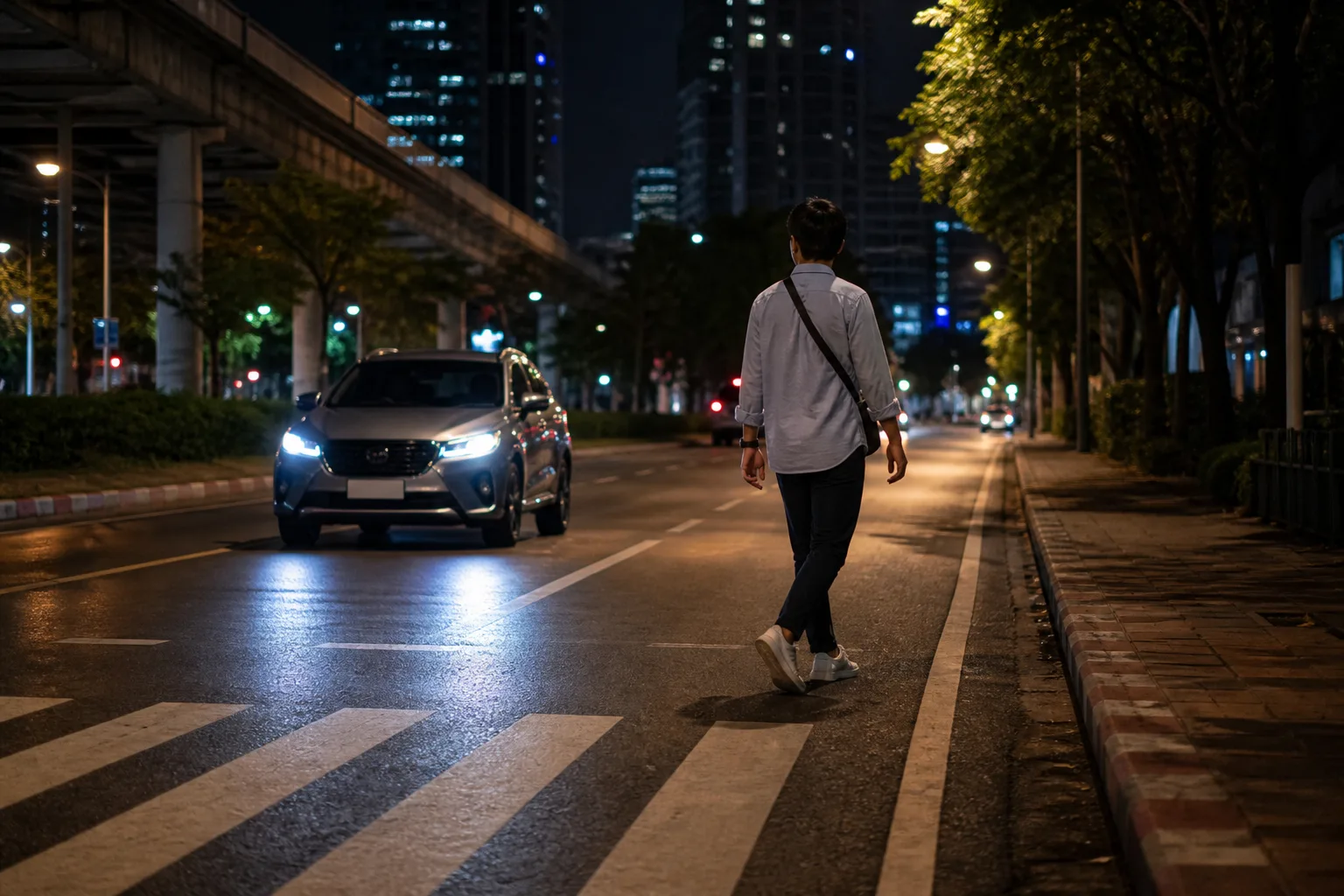
In a drunk pedestrian accident in Thailand, an intoxicated person may cross outside a designated crossing and be struck by a vehicle. Is the pedestrian entirely at fault?
Under Thai law, the answer is not automatic. A pedestrian may breach the traffic rules or contribute to the accident, but that does not by itself remove the driver’s duty to use reasonable care. Criminal liability, civil compensation and traffic offences must each be considered separately, based on the evidence and the circumstances immediately before the collision.
This article explains the main rules and the lesson from Thai Supreme Court Judgment No. 4473/2536. The judgment number is sometimes incorrectly reproduced online as 4473/2563; the correct year is 2536 (1993).
1. Crossing Rules in a Drunk Pedestrian Accident in Thailand
Section 104 of the Road Traffic Act B.E. 2522 (1979) generally requires a pedestrian who is within 100 metres of a designated pedestrian crossing to use that crossing. A designated crossing may include a marked crosswalk or another crossing facility recognised under the traffic rules.
Accordingly, if a person crosses elsewhere while within that 100-metre zone, the pedestrian may commit a traffic offence. Two qualifications are important:
- the 100-metre condition must be established by evidence; and
- the pedestrian’s traffic violation does not automatically prove that the driver exercised sufficient care.
If the nearest designated crossing is more than 100 metres away, Section 104 may not apply in the same way. The pedestrian must still take reasonable care, and their manner of crossing may remain relevant to civil fault and causation.
2. Why Can a Driver Be Liable Even When Driving Within the Speed Limit?
A posted speed limit is a maximum, not a guarantee that the chosen speed is safe in every situation. A driver must adapt to the road, visibility, traffic, weather and foreseeable hazards.
The Road Traffic Act contains duties requiring drivers to avoid careless or dangerous driving and to take care not to collide with pedestrians. In a criminal negligence case, the court asks whether the driver failed to exercise the care that a reasonable driver could and should have exercised in the same circumstances.
The court may therefore consider:
- Visibility: Was the road illuminated? Was the pedestrian visible against the background?
- Observation distance: For how long and from what distance could the driver have seen the pedestrian?
- Speed in context: Even if the vehicle was below the posted limit, was the speed excessive for the actual hazard?
- Reaction: Did the driver brake, reduce speed, sound a warning or steer away when it was safe to do so?
- Road position: How many traffic lanes had the pedestrian already crossed?
- Pedestrian movement: Was the person running suddenly, standing still, walking slowly or staggering?
- Obstructions: Did another vehicle, a roadside object or poor lighting prevent the driver from seeing the pedestrian?
- Physical evidence: What do CCTV footage, dashcam video, skid marks, impact damage and accident reconstruction show?
The central issue is not simply, “Was the driver within the limit?” It is, “Was the driving reasonably careful in the conditions that actually existed?”
3. Supreme Court Judgment No. 4473/2536
This judgment is an important illustration of how Thai courts assess driver negligence when an intoxicated pedestrian crosses a multi-lane road.
Material facts
The deceased was intoxicated and staggered while crossing the road. The pedestrian had already passed through two traffic lanes before the defendant’s vehicle struck the pedestrian in the third lane. The vehicle was travelling at approximately 60–70 kilometres per hour.
The Court’s reasoning
The Supreme Court reasoned that an intoxicated person who was staggering would not move as quickly as an ordinary pedestrian. Because the deceased had already crossed two lanes, the pedestrian had been on the roadway for a meaningful period. A sufficiently careful driver should have been able to observe the person from a distance and take action to avoid the danger.
The collision was therefore attributed to the defendant’s negligence and was not treated as an unavoidable event.
What the judgment does—and does not—mean
The judgment does not create a rule that a driver is always liable whenever an intoxicated pedestrian is struck. It shows that the pedestrian’s intoxication and unlawful crossing do not end the inquiry. The result depends on whether the danger was visible and avoidable in the particular circumstances.
By contrast, where a person suddenly runs or steps into the vehicle’s path at such close range that a careful driver has no realistic time or distance to react, the evidence may support a finding that the collision was unavoidable and that the driver was not criminally negligent.
4. Criminal Liability, Traffic Offences and Civil Compensation
Different legal questions should not be combined into a single conclusion about who was “wrong.”
The pedestrian
An intoxicated pedestrian crossing outside a designated crossing may be liable for a traffic offence if the legal conditions under Section 104 are met. The pedestrian’s conduct may also amount to contributory fault in a civil compensation claim.
It is too broad, however, to say that a pedestrian can never face criminal consequences. In the usual case where the pedestrian is the injured or deceased person, the main criminal-negligence investigation concerns the driver. Different facts—such as conduct causing injury to another road user—could raise other issues.
The driver
Depending on the injury and evidence, a negligent driver may face:
- a traffic offence for careless or unsafe driving;
- an offence under Section 300 of the Criminal Code if the negligence causes grievous bodily harm; or
- an offence under Section 291 if the negligence causes death.
The prosecution must still prove the driver’s negligent act and the causal connection to the injury or death. A collision alone is not conclusive proof of criminal negligence.
Civil compensation
A pedestrian or the lawful heirs of a deceased pedestrian may claim compensation even where the pedestrian contributed to the accident. Under Sections 442 and 223 of the Civil and Commercial Code, the court may reduce compensation to reflect the injured person’s contribution to the damage.
The criminal and civil outcomes need not be identical. A criminal case requires proof of the charged offence to the criminal standard, while a civil court allocates responsibility and compensation under civil-law principles.
5. Practical Comparison of the Parties’ Duties
| Issue | Intoxicated pedestrian crossing outside a crosswalk | Driver |
|---|---|---|
| Traffic duty | Must use a designated crossing when Section 104 applies and must cross with reasonable care | Must observe the road, control speed and avoid careless or dangerous driving |
| Criminal exposure | A traffic offence may arise; other criminal exposure depends on the facts | Sections 291 or 300 may apply if negligent driving causes death or grievous injury |
| Civil effect | Conduct may constitute contributory fault and reduce compensation | May owe compensation if negligent driving caused or contributed to the damage |
| Key evidence | Distance from crossing, intoxication, direction and speed of movement, time on road | Speed, visibility, reaction time, braking, obstruction, dashcam and vehicle data |
6. Evidence That Should Be Preserved Immediately
Liability often turns on a few seconds of evidence. The following material should be preserved as soon as possible:
- original dashcam files, not only a compressed clip sent through a messaging app;
- CCTV footage from shops, residences, public authorities and nearby vehicles;
- photographs showing lighting, lane markings, signs and the nearest crossing;
- measurements of the collision point and distance from the designated crossing;
- skid marks, debris, vehicle damage and final resting positions;
- vehicle speed, GPS or event-data records where available;
- alcohol test results and medical records;
- statements from independent witnesses; and
- police diagrams, daily reports, interview records and expert reports.
CCTV systems frequently overwrite recordings. A preservation request should therefore be made promptly. The scene should also be examined at a similar time of day because lighting and traffic conditions may materially affect visibility.
Frequently Asked Questions
If an intoxicated pedestrian suddenly jumps in front of the car, is the driver liable?
Not necessarily. If the danger arose at such close range that a reasonably careful driver could not stop or avoid the collision, the driver may not be criminally negligent. The conclusion depends on objective evidence, particularly video, speed, sight distance and reaction time.
Can a pedestrian who crossed outside a crosswalk still claim compensation?
Yes. Crossing outside a designated crossing does not automatically extinguish the claim. If the pedestrian contributed to the accident, the court may reduce the compensation according to the circumstances and each party’s contribution.
Does intoxication make the pedestrian automatically responsible?
No. Intoxication is relevant to the pedestrian’s conduct and credibility, but it does not excuse a driver who had sufficient time and distance to see and avoid the danger. Supreme Court Judgment No. 4473/2536 illustrates this point.
What evidence do the police examine?
Investigators commonly examine dashcam and CCTV footage, lighting, skid marks, vehicle damage, witness accounts, alcohol results and the time the pedestrian was visible in the traffic lanes. The police investigate and form a case opinion; guilt is ultimately determined through the criminal justice process, not by the police alone.
What should a driver do immediately after the collision?
Stop safely, protect the scene from further danger, call emergency services and the police, assist the injured person where possible, notify the insurer and preserve all recordings. Do not leave the scene or alter evidence. A driver facing serious injury or death allegations should obtain legal advice before giving a detailed statement.
Key Takeaway
In a drunk pedestrian accident in Thailand, fault is not decided solely by asking whether the pedestrian used a crosswalk or whether the driver stayed below the speed limit. The court examines the complete sequence: visibility, time on the road, speed, distance, reaction and whether the collision could reasonably have been avoided.
Siam Center Law Group advises drivers, injured persons, families and insurers on road-traffic investigations, criminal negligence and civil compensation claims. Early legal review can help preserve time-sensitive evidence, identify the correct legal issues and prevent an incomplete account of the accident from becoming the accepted version of events.
This article provides general information only and is not legal advice. Liability depends on the evidence and the law in force at the relevant time. Any Supreme Court judgment should be applied to materially comparable facts and reviewed with the full decision where available.