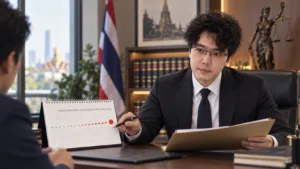
You can divorce a foreign spouse in Thailand either by mutual-consent registration or by obtaining a final judgment from a Thai court. Nationality alone does not force every couple into litigation. The correct route depends on how and where the marriage was registered, whether both spouses agree, whether a Thai court has jurisdiction, the national law of each spouse, where the other spouse can be served, and where the children and assets are located.
Cross-border divorce is more complicated than an ordinary domestic divorce because one case may involve Thai family law, the Act on Conflict of Laws, overseas service of court documents, authentication of foreign records and enforcement in another country. The plan should therefore be designed before proceedings begin—not after a judgment has already been obtained.
Can a Thai–foreign couple divorce by agreement?
Yes, in appropriate cases. Section 1514 of the Thai Civil and Commercial Code recognises two routes: divorce by mutual consent and divorce by court judgment. A consensual divorce must be made in writing, signed by at least two witnesses and registered to take effect.
A foreign spouse does not automatically prevent registration at a Thai district office. Couples married under Thai law may also be able to register a consensual divorce at a Thai embassy or consulate authorised to act as a family-registration office. Some missions permit the spouses to sign at different Thai registration offices when they live in different countries, but the procedure and documentary requirements must be confirmed with the relevant offices in advance.
Before signing, the divorce agreement should deal expressly with children, maintenance, matrimonial property, debts, transfer taxes and costs, use of the family home, and how foreign assets or orders will be dealt with. A one-page agreement that says only that the parties wish to divorce may leave the most expensive disputes unresolved.
Mutual-consent divorce compared with court divorce
| Issue | Mutual-consent registration | Contested divorce in court |
|---|---|---|
| When available | Both spouses freely agree and the divorce is permitted under the applicable nationality laws | One spouse does not agree, cannot be located, or disputes children, property or support |
| Legal basis | Written agreement, at least two witnesses and registration under Section 1514 | A statutory ground under Section 1516, plus jurisdiction and conflict-of-laws requirements |
| Attendance | Usually personal attendance before a registrar; different-office procedures may be available | The claimant acts through the court; the defendant must be lawfully served and may defend |
| Timing | Potentially completed promptly after documents and appointments are ready | No reliable fixed period; overseas service, evidence, mediation, appeals and asset disputes may substantially extend the case |
| Best use | The parties can settle all major consequences in a carefully drafted agreement | There is no genuine consent or binding court orders are required |
When can a Thai court grant a divorce involving a foreign spouse?
It is not enough simply to show that one spouse is Thai or that the marriage was recorded in Thailand. Counsel should check the Thai court’s subject-matter and territorial jurisdiction, the parties’ domicile or residence, the place connected with the claim and any pending foreign proceedings.
Sections 26 and 27 of the Act on Conflict of Laws B.E. 2481 (1938) are especially important:
- a divorce by mutual consent is valid only if the national law of each spouse permits that form of divorce;
- a Thai court cannot grant a divorce unless divorce is permitted by the national law of each spouse; and
- the grounds for divorce are governed by the law of the place where the action is filed—Thai law when the case is brought in Thailand.
Foreign-law questions usually require reliable proof of the relevant foreign law, not an unsupported statement by a party. Depending on the case, this may involve an official legal text, expert evidence, a legal opinion or a certificate from an appropriate authority, with a Thai translation.
What grounds and evidence are required?
A spouse seeking a contested divorce must plead and prove at least one ground under Section 1516. Common grounds include adultery or openly maintaining another person as a spouse, serious misconduct, physical or mental harm, serious insult, intentional desertion for more than one year, failure to provide proper support, and qualifying periods of separation.
“We no longer get along” is not, by itself, a complete ground for a unilateral divorce. The evidence should be matched to the particular statutory ground. Useful material may include:
- marriage and household-registration records;
- travel and immigration records relevant to separation or desertion;
- bank statements, remittance history and proof of household support;
- messages, photographs, public posts and witness testimony, obtained lawfully;
- medical records, police reports or protection orders where violence is alleged; and
- documents identifying property, debts, companies and beneficial ownership.
The pleading should state the material facts, dates and requested remedies precisely. If damages against a third party, child orders, maintenance or division of matrimonial property are sought, limitation periods and procedural requirements should be checked before filing.
How are court papers served when the foreign spouse is overseas?
A defendant living abroad may still be sued in an appropriate Thai court, but lawful service is essential. The claimant should provide the most accurate residential or business address available. Email addresses, telephone numbers, social-media accounts, immigration records and contact details of relatives can assist enquiries, but they do not automatically replace formal service.
Under Thai civil procedure, a court may request assistance abroad through an applicable treaty or judicial-cooperation arrangement, or through diplomatic channels and the principle of reciprocity. The destination country’s rules may require prescribed forms, certified translations, advance expenses or service through a designated authority. Thailand was not listed as a party to the 1965 Hague Service Convention as of 17 September 2026, so counsel should not assume that the Convention’s central-authority procedure applies to a Thai action.
Service abroad can be the longest stage of the case. An incorrect address, incomplete translation or use of a method not recognised by the destination country can delay the hearing and may later expose the judgment to challenge.
Do all foreign documents require translation and legalisation?
Documents filed in a Thai court generally need a Thai translation, but the necessary authentication depends on the document, issuing country, intended use and the court’s directions. It is too broad to say that every foreign document must always be legalised by both an embassy and the Thai Ministry of Foreign Affairs.
Typical documents include the foreign spouse’s passport and civil-status records, a foreign marriage certificate, address evidence, corporate records and documents proving foreign law. The originals, certified copies, translator’s certification, notarisation, consular legalisation and Thai translation should be planned as one chain.
Thailand deposited its accession to the Apostille Convention on 30 June 2026, but the Convention is scheduled to enter into force for Thailand on 28 February 2027. As of 17 September 2026, practitioners should therefore continue checking the existing legalisation route rather than assuming that an apostille alone is already sufficient for use in Thailand.
How is matrimonial property divided?
Thai law distinguishes personal property (sin suan tua) from matrimonial property (sin somros). The title shown on a document is important evidence but does not always determine the classification. Property acquired during marriage is commonly matrimonial property unless an exception or valid marital agreement applies.
After the marriage ends, matrimonial property is liquidated after relevant liabilities are dealt with and is generally divided equally under Sections 1532 and 1533. The analysis should cover both assets and debts, including real estate, bank and investment accounts, companies, vehicles, pensions, digital assets and liabilities incurred for family affairs.
Foreign property requires a separate enforcement plan. Thai conflict-of-laws rules generally give special importance to the law of the place where immovable property is situated. Even if a Thai judgment determines rights between the spouses, a foreign land registry or court may require recognition or fresh proceedings before the asset can be transferred or sold.
Where there is a risk that assets will be sold, concealed or transferred, counsel should consider preservation evidence and any available interim measures before giving advance notice of the claim.
Children, parental power and maintenance
Where the spouses have children, the case should address parental power, the child’s habitual living arrangements, contact, travel consent, passport control, education, healthcare and maintenance. The child’s welfare is central, but international elements may affect jurisdiction, applicable law and enforcement.
Neither parent should remove a child across borders merely because divorce proceedings have started. An international relocation without proper consent or authority can produce urgent proceedings in more than one country. The child’s location and any immediate travel risk should therefore be disclosed to counsel at the beginning.
What happens after the Thai judgment becomes final?
A divorce by judgment takes effect when the judgment becomes final. Under Section 1531, however, it cannot be asserted against a good-faith third party until it is registered. The final judgment and certificate of finality should therefore be used to update the Thai family-registration record promptly.
If the divorce must also be recognised abroad, the Thai judgment does not automatically update every foreign civil registry or make every Thai property, maintenance or child order directly enforceable overseas. The required process depends on the other country’s law and may involve a certified final judgment, translation, legalisation or apostille when applicable, registration of foreign divorce, recognition proceedings or a new local application.
Practical checklist before filing
- Map the legal connections: nationality, domicile, residence, place of marriage, location of children and location of assets.
- Choose the correct route: genuine consensual registration or a court claim based on a provable statutory ground.
- Confirm jurisdiction and foreign law: do not assume that a Thai marriage certificate alone resolves these issues.
- Locate the other spouse: obtain a serviceable overseas address and identify the destination country’s service requirements.
- Preserve evidence and assets: collect lawful evidence before accounts, messages or property records disappear.
- Draft all necessary claims together: divorce, property, debts, parental power, child and spousal maintenance, and any permitted damages.
- Plan recognition and enforcement: decide what must happen in every country connected to the family or property.
Frequently asked questions
My foreign spouse returned home and cannot be contacted. Can I still file in Thailand?
Potentially yes, if the Thai court has jurisdiction and the conflict-of-laws requirements are satisfied. You must provide all available address information and ask the court to direct a lawful method of service. Inability to contact the spouse does not automatically permit the service stage to be skipped.
Must the foreign spouse travel to Thailand for a consensual divorce?
Not always. Depending on the marriage record, nationality and country of residence, the spouses may be able to use a Thai embassy or consulate or a different-registration-office procedure. Confirm the exact procedure with both registration offices before preparing the agreement or booking travel.
How long does a contested cross-border divorce take?
There is no dependable universal estimate. A straightforward defended case and a case requiring overseas service, proof of foreign law, valuation of businesses, child evidence or an appeal have very different timelines. Any quotation such as “six months to one year” should be treated as a planning estimate, not a promise.
Will a Thai divorce judgment automatically divide property overseas?
Usually not by itself. The country where the asset is located decides whether and how it recognises and enforces the Thai judgment. Foreign immovable property, trusts, companies and retirement assets require country-specific advice.
Key takeaway
To divorce a foreign spouse in Thailand, begin with jurisdiction, applicable nationality law and service—not merely the grounds for divorce. Mutual-consent registration may be available and is often the most efficient route when the agreement is complete. If court proceedings are necessary, overseas service, foreign documents, children, assets and recognition abroad should be built into one coordinated strategy from the outset.
About the author: Siam Center Law Group Legal Team. We advise Thai and international clients on divorce, parental power, maintenance, matrimonial property and cross-border family disputes.
This article provides general information under Thai law as of 17 September 2026. It is not legal advice for a particular family or jurisdiction. Foreign-law and recognition issues must be checked in the relevant country.
Official references
- Thai Civil and Commercial Code, Sections 1514, 1516 and 1531–1533.
- Act on Conflict of Laws B.E. 2481 (1938), National Library of Thailand, particularly Sections 26 and 27.
- Royal Thai Embassy, The Hague: divorce registration under Thai law.
- Department of Consular Affairs: document legalisation.
- Court of Justice article on service of judicial documents abroad.
- HCCH Apostille Convention status table.
- HCCH Service Convention status table.