
Criminal Procedure in Thailand: A Practical Legal Guide for Defendants, Victims, and Interested Parties
Introduction
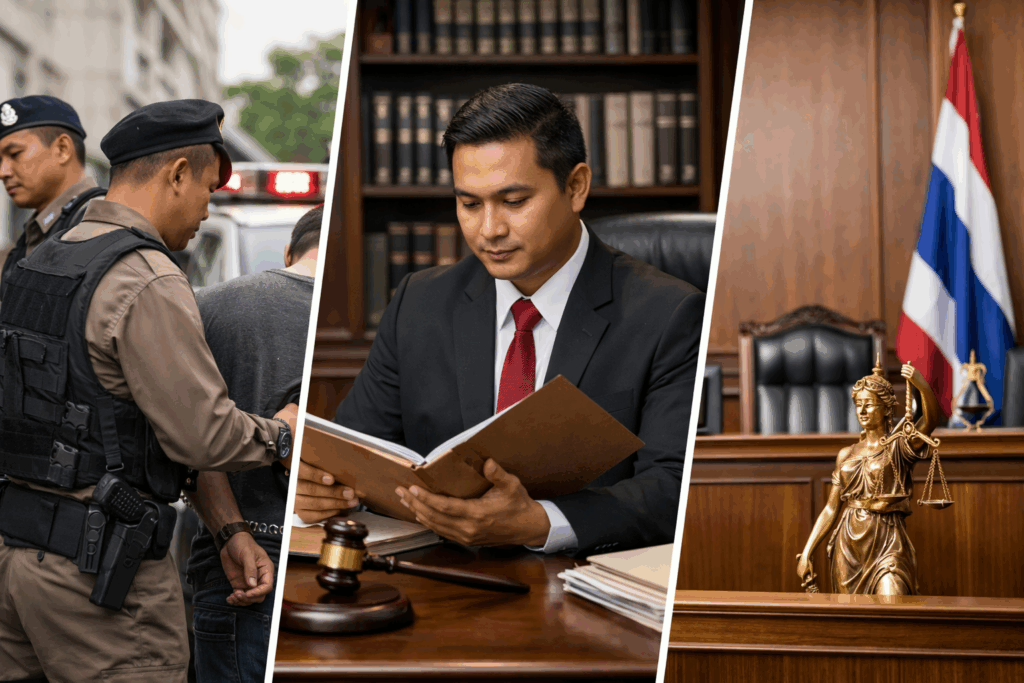
Criminal Procedure in Thailand governs how criminal cases are investigated, prosecuted, adjudicated, and enforced. Unlike substantive criminal law, which defines what constitutes an offence, criminal procedure focuses on how the State exercises its power against individuals, and how individuals may protect their rights within the justice system.
For defendants, victims, and the general public in Thailand, misunderstandings about criminal procedure often lead to serious legal disadvantages—such as invalid investigations, loss of procedural rights, or unnecessary delays. This article provides a structured and practical explanation of Thai criminal procedure, written in an academic and professional legal tone, while remaining accessible to non-lawyers.
Overview of the Thai Criminal Justice System
The Role of Criminal Procedure Law in Thailand
Criminal Procedure in Thailand is primarily governed by the Criminal Procedure Code (CPC). The Code regulates every stage of a criminal case, from the filing of a complaint to investigation, prosecution, trial, appeal, and execution of judgment.
The system is based on the principle that:
-
Criminal prosecution is generally conducted in the name of the State, and
-
Procedural safeguards exist to ensure fairness, legality, and proportionality.
Key Authorities in Thai Criminal Proceedings
Police and Investigation Officers
The police are responsible for conducting criminal investigations. However, their authority is strictly limited by territorial jurisdiction and statutory rules under the Criminal Procedure Code.
Public Prosecutors
Public prosecutors have exclusive authority to decide whether to indict a case, except in limited categories where private prosecution is permitted.
Criminal Courts
Thai courts adjudicate criminal cases based on evidence presented during trial, not merely on the investigation file.
Investigation Authority Under Criminal Procedure in Thailand
Territorial Jurisdiction of Investigation Officers
Under Section 18 of the Criminal Procedure Code, investigation authority generally lies with:
-
The officer in whose jurisdiction the offence occurred
-
The officer in whose jurisdiction the suspect was arrested
-
The officer in whose jurisdiction the suspect resides
However, not all locations confer investigative authority.
No Authority Based on Transit Alone
A jurisdiction merely passed through by a suspect does not automatically gain investigation authority.
Multiple Jurisdictions and Connected Offences
Under Section 19, where:
-
An offence occurs across multiple jurisdictions, or
-
Several connected offences arise from the same criminal transaction
More than one investigation officer may have authority. Nevertheless, only one officer is deemed the “responsible investigator”, determined by factual priority such as:
-
Where the offence was first discovered
-
Where a complaint was first filed
This distinction is critical, as improper assumption of responsibility can invalidate the investigation.
Consequences of an Unlawful Investigation
Effect on Prosecution Authority
If an investigation is conducted by an officer without lawful authority from the outset, the investigation may be deemed invalid.
Under Section 120, an invalid investigation may result in:
-
The public prosecutor lacking authority to file charges
-
The criminal case being dismissed on procedural grounds
This principle highlights the importance of procedural legality, even where factual guilt may exist.
Completeness of the Case File in Thai Criminal Procedure
Duty to Compile a Complete Investigation Record
Under Section 139, investigation officers must compile all evidence obtained, including:
-
Statements favourable to the suspect
-
Statements later retracted
-
Evidence deemed irrelevant or weak by the officer
Police officers have no discretion to remove evidence from the case file.
Role of Prosecutors and Courts
The evaluation of evidence is reserved for:
-
Public prosecutors at the indictment stage
-
Courts during trial
Selective filing by investigators is prohibited.
The Role of the Public Prosecutor in Criminal Procedure in Thailand
Prosecutorial Discretion
Public prosecutors may:
-
Order further investigation
-
Dismiss charges
-
File an indictment
However, prosecutors cannot cure fundamental defects in investigation authority.
Prosecutor’s Authority to Claim Compensation
Under Section 43, prosecutors may claim:
-
Return of stolen property
-
Monetary value of such property
This authority is strictly limited and applies only to specific offences such as theft, robbery, and receiving stolen property.
Victims’ Rights to Claim Damages in Criminal Cases
Civil Claims Within Criminal Proceedings
Under Section 44/1, victims may file civil claims for damages within the criminal case, including:
-
Medical expenses
-
Loss of income
-
Pain and suffering
This mechanism allows victims to seek compensation without filing a separate civil lawsuit.
Jurisdiction for Civil Claims
Such claims may be filed before:
-
The criminal court hearing the case, or
-
A civil court with proper jurisdiction
Withdrawal of Charges and Procedural Irregularities
Withdrawal of Private Participation
Withdrawal from being a joint plaintiff does not constitute:
-
Withdrawal of prosecution
-
Settlement of the case
Victims may rejoin the case as joint plaintiffs before judgment at first instance.
Fraudulent Withdrawal and Irregular Proceedings
If a case is withdrawn due to forged documents or fraud:
-
The proceedings are deemed procedurally defective
-
The court may revoke the withdrawal order and resume proceedings
This remedy exists even after appeal deadlines have passed.
Transfer of Criminal Cases Between Courts
Transfer for Convenience (Section 23)
Cases may be transferred to promote convenience and efficiency, typically linked to the place where the offence occurred.
Transfer for Security or Public Order (Section 26)
Transfers under Section 26 require:
-
Serious threats to safety or public order
-
Authorization by the President of the Supreme Court
Victim Status and Legal Standing
Victims with Contributory Fault
Individuals who:
-
Voluntarily participated in a fight, or
-
Acted with contributory negligence
May lose standing as criminal victims, but still retain civil claims for damages.
Rights of Suspects and Accused Persons
Notification of Charges
Failure to properly inform a suspect of the factual basis of charges may render that part of the investigation unlawful.
Right to Remain Silent
Statements obtained without informing the suspect of the right to remain silent are inadmissible, though the entire investigation may remain valid.
Overseas Offences and Thai Criminal Procedure
Extraterritorial Crimes
Offences committed outside Thailand fall under Section 20, requiring authorization by the Attorney General.
Without such authorization:
-
Investigation and prosecution are invalid for those offences
However, offences committed within Thailand may still be prosecuted separately.
Juveniles in Criminal Procedure in Thailand
Filing Complaints by Minors
Minors may file criminal complaints independently.
Legal Representation
Participation as a joint plaintiff must be conducted through a legal guardian until the minor reaches legal age.
Single Act, Multiple Offences, and Withdrawal of Complaints
Where a single act constitutes:
-
A compoundable offence, and
-
A non-compoundable offence
Withdrawal of the complaint extinguishes only the compoundable offence. The public offence remains prosecutable.
Conclusion: Why Criminal Procedure in Thailand Matters
Criminal Procedure in Thailand is not merely technical law. It is the framework that ensures:
-
State power is exercised lawfully
-
Individual rights are protected
-
Criminal justice is administered fairly
For defendants, victims, and the general public, understanding procedural rules can make the difference between justice and irreversible loss of rights. For this reason, early legal consultation with a qualified criminal lawyer is essential whenever criminal liability may arise.
About Our Practice
Our firm provides legal advice and representation in criminal cases across Thailand, with a focus on procedural legality, rights protection, and strategic litigation management.