
Public Prosecutor vs Private Prosecution in Thailand: 7 Key Differences in Criminal Cases
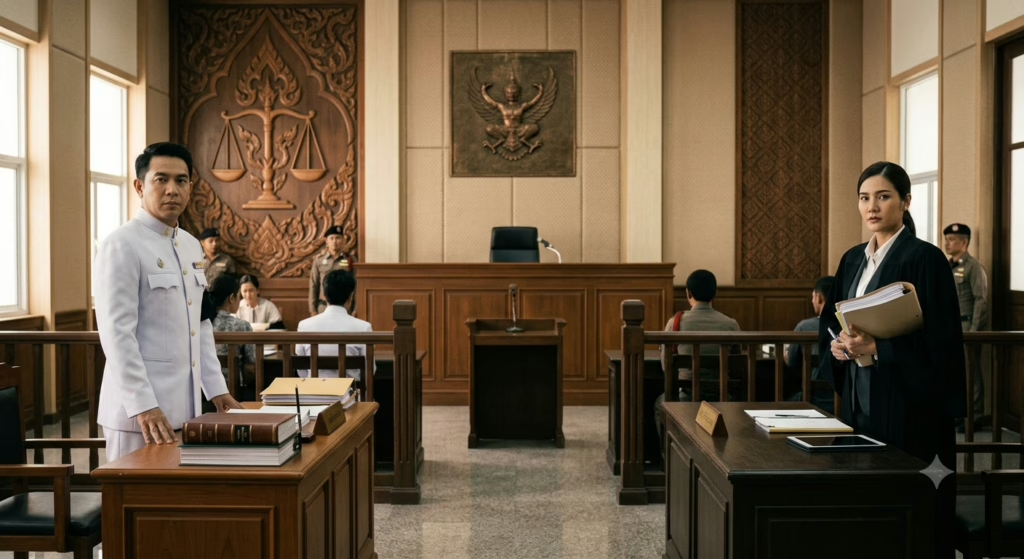
Under Thai criminal law, criminal proceedings may be initiated in two different ways. A case may be prosecuted by the Public Prosecutor on behalf of the State after a police investigation, or in certain circumstances, the injured person (victim) may file a criminal complaint directly with the court as a private prosecutor.
Although both procedures involve criminal prosecution, they differ significantly in terms of pre-trial procedures, evidentiary strategy, arrest procedures, settlement options, appeals, and litigation tactics.
Understanding these differences is essential for both defendants and victims when evaluating legal strategy and protecting their rights.
This article explains seven key differences between public prosecution and private prosecution under Thai law.
1. The Pre-Trial Process Is Different
When the Public Prosecutor Files the Case
Most criminal cases begin with a police investigation. After collecting evidence and interviewing witnesses, the police submit the investigation file to the Public Prosecutor, who decides whether sufficient evidence exists to prosecute.
Because of this process, the investigation stage is often critical. Statements made during police interviews and evidence submitted at this stage may significantly affect the outcome of the trial.
When the Victim Files the Case Directly
Thai law permits an injured person to commence certain criminal proceedings directly before the court.
Before accepting the case for trial, however, the court must conduct a preliminary examination (preliminary inquiry) to determine whether the complaint contains sufficient grounds to proceed.
At this stage, the defendant is generally not required to present a full defence but may cross-examine the complainant’s witnesses to challenge their credibility and obtain valuable information for the trial.
2. Arrest Warrants and Bail Procedures
When a criminal case is prosecuted by the Public Prosecutor, the court may issue an arrest warrant where the legal requirements are satisfied, particularly in serious offences or where there is reason to believe the accused may abscond or interfere with evidence.
In contrast, where the victim files a private criminal complaint, the court generally conducts the preliminary examination before deciding whether the case has merit. If the complaint is accepted, the court will often issue a summons first, with an arrest warrant being considered only where legally justified.
Consequently, the procedural timeline and the manner in which the accused enters the court process may differ depending on who initiates the prosecution.
3. Trial Strategy and Witness Examination
Public Prosecution
In cases prosecuted by the Public Prosecutor, the victim may apply to join the proceedings as a co-prosecutor.
If permitted by the court, the defendant may face both the prosecutor and the victim’s legal representatives throughout the trial.
Furthermore, inconsistencies between the defendant’s police statement and testimony given in court may be used during cross-examination to challenge credibility.
Private Prosecution
Private prosecutions provide a unique procedural feature.
Because the complainant normally gives evidence during both the preliminary examination and the trial, the defence has two opportunities to cross-examine the complainant.
Any inconsistencies between those testimonies may affect the weight and credibility of the complainant’s evidence.
Accordingly, careful analysis of testimony given during the preliminary examination is often an important component of the defence strategy.
4. Settlement and Withdrawal of Criminal Proceedings
One of the most significant procedural differences concerns settlement.
In cases prosecuted by the Public Prosecutor involving offences against the State (non-compoundable offences), a private settlement between the victim and the accused does not automatically terminate the prosecution. The Public Prosecutor remains responsible for proceeding in accordance with the law unless there is a legal basis for discontinuing the case.
By contrast, where the victim personally initiates a private criminal prosecution, Thai law may allow the complainant to withdraw the complaint before the trial court renders judgment, subject to the applicable legal requirements.
This may create greater opportunities for negotiated resolutions in appropriate cases.
5. Appeal and Supreme Court Review
When both the Public Prosecutor and the victim participate as co-prosecutors, each party may possess independent procedural rights regarding appeals, subject to Thai procedural law.
In some circumstances, even if the Public Prosecutor chooses not to appeal, the co-prosecutor may still be entitled to file an appeal or petition the Supreme Court independently.
Therefore, parties should carefully monitor all appeal deadlines even after a favourable judgment at first instance.
6. Legal Issues and Defence Strategies
Certain legal arguments arise only in private prosecutions.
One important example concerns the complainant’s legal standing as an injured person under Thai law. If the complainant does not qualify as a legally recognised injured person, they may lack standing to bring a private criminal prosecution.
Another strategic issue involves access to the investigation file. Where relevant evidence beneficial to the defence has not been disclosed, defence counsel may request that the court order production of the investigation records or other relevant documents, subject to applicable procedural rules.
7. The Legal Consequences After the Case Ends
The legal consequences following the conclusion of criminal proceedings also differ depending on who initiated the prosecution.
For example, if the Public Prosecutor decides not to prosecute, the injured person may still have legal remedies available, including the possibility of commencing a private prosecution where permitted by law.
Conversely, where a private prosecution concludes with a final judgment, any subsequent proceedings concerning the same offence must be considered in light of the legal principles governing double jeopardy, final judgments, and res judicata under Thai law.
Each case depends upon its own procedural history and specific legal circumstances.
Conclusion
Although both public prosecution and private prosecution are recognised under Thailand’s criminal justice system, they involve different procedural rules, litigation strategies, and legal consequences.
From investigation procedures and preliminary examinations to settlement opportunities, appeals, and evidentiary tactics, understanding these distinctions is essential for both victims and defendants.
Because every criminal case presents unique factual and legal issues, obtaining legal advice at an early stage can help parties evaluate their rights, preserve important evidence, and develop an effective litigation strategy.