
Defamation Damages: How Much Can You Actually Claim? A Comprehensive Legal Guide to Reputation Valuation
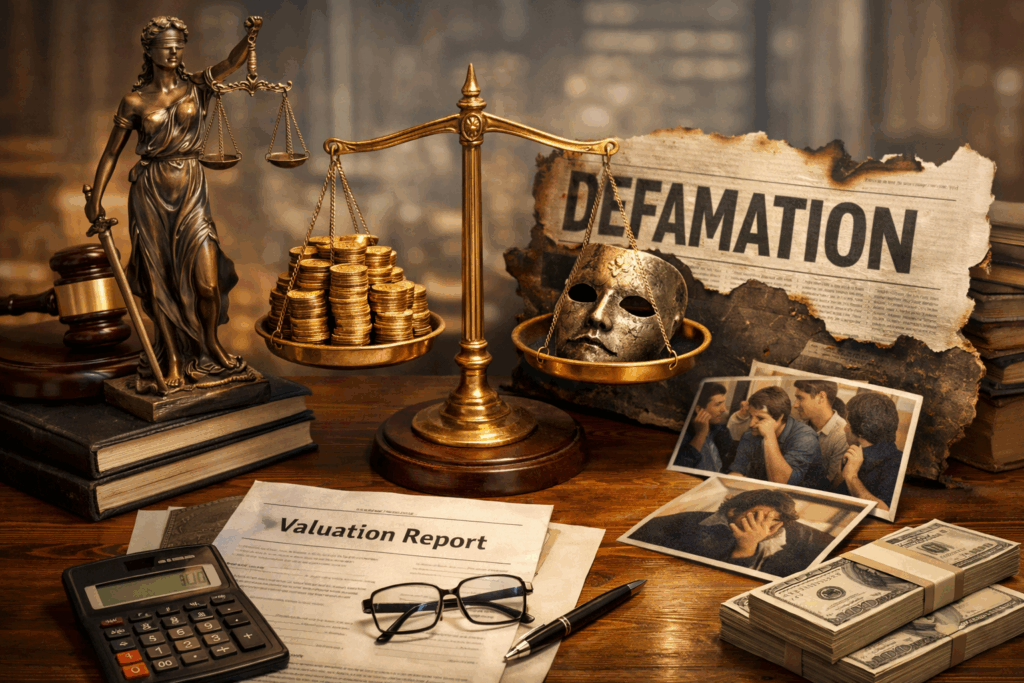
When an individual or a business falls victim to a character attack, the immediate instinct is to seek justice through the court system. However, a question frequently posed to legal counsel is: “How much are defamation damages worth?” In the realm of tort law, quantifying the value of a person’s reputation is one of the most complex tasks a court faces.
Unlike a breach of contract where financial loss is often liquidated and easily calculable, defamation involves “General Damages”—compensation for non-pecuniary losses such as emotional distress, humiliation, and the loss of social standing. This article explores the legal frameworks, judicial benchmarks, and the seven critical factors courts use to determine the final award.
The Legal Nature of Defamation Damages
In most jurisdictions, defamation is categorized as a civil wrong (tort). The primary goal of awarding damages is Restitutio in Integrum—to restore the plaintiff, as much as money can, to the position they would have been in had the defamatory statement never been made.
Types of Damages in Defamation Suits
-
General Damages: Compensation for harm to reputation and feelings.
-
Special Damages: Quantifiable monetary losses (e.g., loss of a specific job or contract).
-
Aggravated Damages: Increased awards if the defendant acted with malice or persisted in the falsehood.
-
Exemplary (Punitive) Damages: Aimed at punishing the defendant rather than compensating the victim (rare in many civil law jurisdictions).
The Judicial Yardstick: 7 Factors Determining the Award
Because there is no “fixed price list” for a slur or a false accusation, the judiciary relies on a multifaceted assessment of the circumstances.
1. Gravity of the Allegation
The nature of the statement is the baseline. Accusing someone of a heinous crime (e.g., fraud or sexual misconduct) carries significantly higher weight than a vague insult or a minor professional criticism. The more specific and damaging the allegation, the higher the baseline for defamation damages.
2. Extent of Publication and Duration
The “Virality” factor is crucial in the digital age.
-
Mass Media/Social Media: A public Facebook post shared thousands of times creates widespread damage.
-
Private Correspondence: A defamatory email sent to a single person may result in nominal damages unless that person is a key decision-maker (like a boss).
-
Permanence: How long was the content online? A post deleted within minutes vs. a blog post indexed on Google for years affects the valuation.
3. The Social and Professional Standing of the Parties
The law acknowledges that some reputations have a higher “market value” in professional terms.
-
Public Figures: While they have a higher threshold to prove defamation in some regions, the damage to a public figure can be calculated in millions if it affects global endorsements.
-
Professionals: For doctors, lawyers, or CEOs, a stain on their integrity can end a career, justifying higher defamation damages.
4. Actual Impact and Consequential Loss
Courts look for “Special Damages.” Did the plaintiff lose their employment? Did they suffer a clinically diagnosed psychological breakdown? The ability to provide medical certificates or termination letters acts as an “anchor” for higher compensation.
5. The Conduct of the Defendant
Aggravated damages are often triggered here. If the defendant:
-
Refused to take down the post after a Cease and Desist.
-
Doubled down on the lie during the trial.
-
Acted with “Express Malice.”
6. Context and Provocation
Sometimes, the court may find the defendant technically guilty but reduce the award if the plaintiff “provoked” the situation. For example, if the defamation occurred during a heated mutual argument or a “tit-for-tat” social media feud, the court may award only symbolic amounts.
7. Mitigation and Apology
A prompt, sincere, and prominent apology can significantly lower the defendant’s liability. If the defendant mitigated the harm by publishing a correction, the court views this as a reduction in the ongoing damage to the plaintiff’s reputation.
Is a Defamation Lawsuit “Worth It”?
From a legal standpoint, plaintiffs must weigh the potential award against the costs of litigation. In many countries, the median award for a standard “social media spat” falls within the $5,000 to $30,000 range. High-profile cases reaching six or seven figures are the exception, not the rule.
The true value of a defamation suit often lies not in the financial windfall, but in the Judicial Declaration of Falsity—a court order that officially clears your name, providing a shield against future character attacks.