
Police Requesting Phone Unlocks: Understanding Legal Boundaries and Citizens’ Rights in Thailand
Introduction
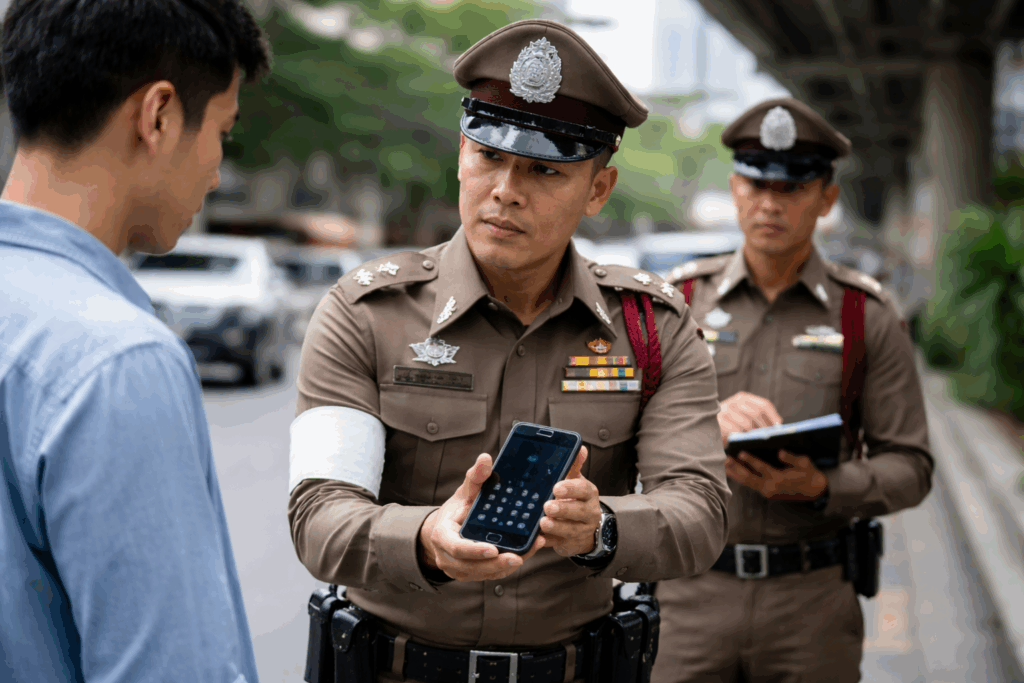
In contemporary Thailand, smartphones and other mobile devices contain vast amounts of personal information, from private messages to financial records. As technology becomes an integral part of daily life, law enforcement increasingly seeks access to these devices during investigations. The issue of police requesting phone unlocks has thus emerged as a significant legal and social concern. Many citizens, however, remain unaware of their rights under Thai law, often feeling compelled to comply with requests that may exceed the officer’s authority.
Understanding the legal framework surrounding police access to mobile devices is essential for protecting one’s rights while complying with legitimate law enforcement activities. This article explores the relevant statutes, constitutional protections, practical guidance for citizens, and emerging issues related to digital privacy in Thailand.
Legal Framework Governing Police Searches in Thailand
Thailand’s legal system provides specific guidance regarding searches and seizures. When it comes to mobile devices, these rules balance investigative needs with citizens’ rights to privacy. The two primary legal frameworks governing these issues are the Criminal Procedure Code and the Computer Crime Act, supplemented by constitutional privacy protections.
Criminal Procedure Code – Section 93
Under Section 93 of the Criminal Procedure Code (CrPC), law enforcement officers may conduct searches of persons or property when there is “reasonable suspicion” that the individual possesses evidence related to a criminal offense, such as weapons, drugs, or stolen property. The law defines the scope of permissible searches, emphasizing that they must be limited to areas where contraband could reasonably be concealed.
It is important to note that reasonable suspicion must be based on objective factors, not simply an officer’s intuition. Courts have consistently held that searches conducted without adequate justification may constitute an unlawful intrusion.
Computer Crime Act and Digital Data Protection
Accessing digital information, including messages, photos, or application data, is governed by the Computer Crime Act (2007). Unlike a physical search, the law recognizes that mobile devices contain sensitive personal information. Police officers cannot compel an individual to unlock a phone to access private data without obtaining a court warrant. This statutory requirement ensures that digital searches are both legal and proportionate.
Protected data under the Act includes:
-
Private chats or messages
-
Photos, videos, and multimedia files
-
Social media accounts and communication apps
-
Browsing history and stored credentials
Violating these protections can result in evidence being excluded from trial and may expose the police to legal liability.
Constitutional Right to Privacy
Thailand’s Constitution further reinforces privacy protections. Sections 32 and 35 guarantee personal liberty and protection against arbitrary interference. Courts have interpreted these provisions to include digital communications, recognizing that mobile devices are extensions of private life. Consequently, citizens have a constitutionally supported expectation of privacy, particularly regarding personal electronic data.
Distinguishing Between Physical Search and Data Access
Understanding the distinction between physical inspection and digital data access is critical for evaluating the legality of a police request.
Physical Search (“Outside the Device”)
Police are legally authorized to inspect the exterior of a device, such as checking for unusual thickness or concealed compartments. Such inspections fall under Section 93 of the CrPC and aim to detect physical contraband. However, examining the device’s internal contents, including messages or apps, exceeds the authority of a mere physical search.
Data Access (“Inside the Device”)
Accessing the contents of a mobile device constitutes a digital search and requires explicit legal authorization. Police must:
-
Seize the device as evidence
-
Obtain a court-issued warrant before unlocking or analyzing stored data
Noncompliance with these requirements may lead to unlawful searches, raising constitutional concerns and potentially jeopardizing prosecutions.
Case Law Examples
Several Thai court cases have underscored the limits of police powers regarding digital data:
-
Example 1: A court held that a warrantless attempt to access a suspect’s private messaging app violated constitutional privacy rights. Evidence obtained was deemed inadmissible.
-
Example 2: In another case, the court emphasized that reasonable suspicion alone does not permit unlocking a phone without judicial oversight.
These decisions reinforce the principle that smartphones are not ordinary containers but repositories of personal information warranting enhanced legal protection.
Practical Guidance for Citizens
Even with strong legal protections, citizens may feel intimidated when confronted by law enforcement. Understanding actionable steps can help protect rights while avoiding confrontation.
Step 1: Verify the Officer’s Identity
Always request official identification, including badge number and department. Recording these details or taking a photograph ensures accurate documentation in case of later disputes.
Step 2: Request Legal Basis
Ask which law or statutory section authorizes the request to unlock the device. Officers must provide a clear legal foundation for the search. Without such justification, compliance is not required.
Step 3: Politely Decline Unlocking Without Warrant
If no warrant or court order exists, individuals have the right to refuse. This can be communicated politely, emphasizing willingness to cooperate with lawful procedures, such as a physical search of the device exterior.
Step 4: Document the Incident
Where feasible, record the interaction via video or audio. This documentation serves as evidence of proper conduct and protects against potential abuse of authority.
Case Studies and Comparative Analysis
Thai Context
Thai courts have increasingly recognized the importance of digital privacy. Notable cases demonstrate that unlawful access to mobile devices can result in evidence exclusion, reinforcing citizens’ rights.
International Perspectives
-
European Union (GDPR & ECHR): Strong protections for personal data, requiring judicial authorization for accessing electronic communications.
-
United States: Fourth Amendment jurisprudence emphasizes warrants for digital searches. Courts have drawn distinctions between physical searches and data extraction.
Comparing Thai legal standards with international norms highlights Thailand’s alignment with global principles while underscoring areas for potential legal reform.
Legal Consequences for Police and Citizens
For Law Enforcement
-
Unauthorized phone unlocks may constitute illegal searches
-
Evidence obtained unlawfully may be inadmissible in court
-
Officers could face administrative or criminal liability
For Citizens
-
Refusal to unlock a phone without a warrant is legally protected
-
Compliance with an unlawful request could waive certain rights
-
Proper documentation ensures defense against potential allegations of obstruction
Emerging Issues and Future Trends
-
Increased reliance on smartphones as investigative tools
-
Debate over the balance between security and privacy
-
Potential legislative amendments to clarify digital search powers
-
Role of legal advice in safeguarding rights and advising on compliance
Legal scholars and policymakers continue to evaluate the intersection of privacy, technology, and law enforcement. Awareness and education remain crucial to protect citizens while enabling lawful investigations.
Conclusion
Situations involving police requesting phone unlocks illustrate the complex intersection of technology, privacy, and law. Citizens should be aware that:
-
Physical inspection of a device is permissible under reasonable suspicion
-
Accessing internal data requires a court warrant
-
Constitutional rights safeguard personal privacy
-
Clear, polite refusal and documentation are essential when confronted with unlawful requests
By understanding these principles, individuals can protect their rights without impeding legitimate law enforcement activities. Mobile devices remain private spaces, and Thai law recognizes the need to balance investigative powers with fundamental privacy protections.