
The Art of Witness Examination: Professional Techniques in Trial Advocacy
Introduction
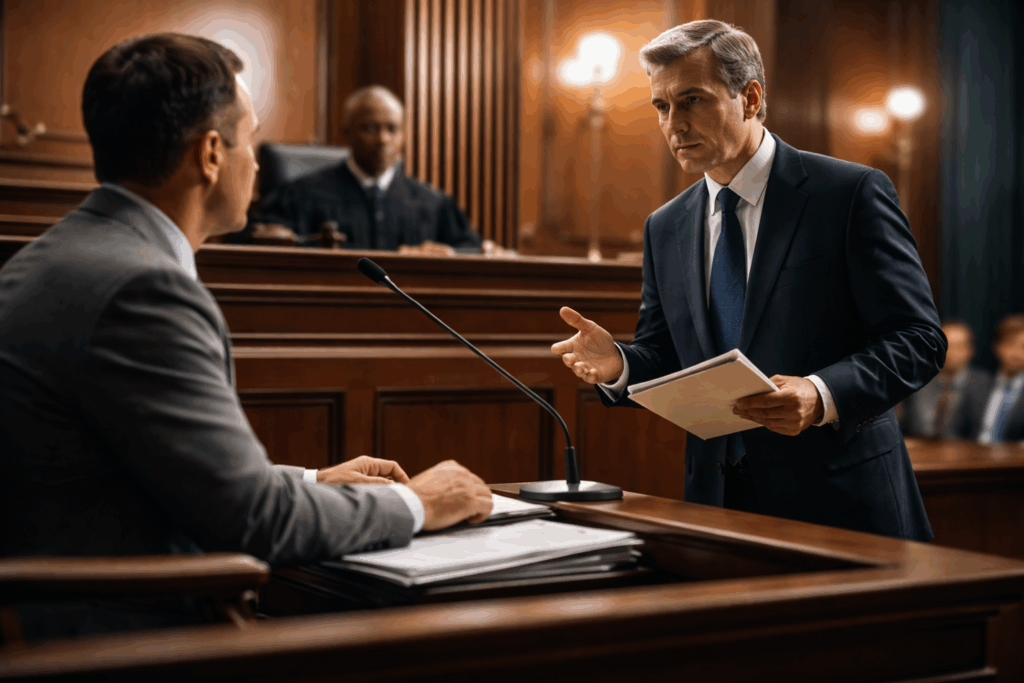
The art of witness examination is one of the most decisive factors in litigation outcomes. In both criminal and civil proceedings, courts do not determine cases solely by reference to statutes, precedents, or written submissions. Instead, judges rely heavily on witness testimony, evaluated through the process of direct examination and cross-examination.
For this reason, witness examination is widely regarded as a core skill of trial advocacy. A professionally conducted examination does not merely extract facts; it organizes facts into a coherent narrative, enhances credibility, and guides the court toward a legally sound and factually persuasive conclusion.
This article examines the art of witness examination from an academic and professional legal perspective. It is written for law firm websites, legal practitioners, and international clients seeking to understand how professional trial lawyers approach witness examination as a strategic discipline rather than a mechanical courtroom task.
Understanding Witness Examination in Legal Proceedings
The Role of Witness Examination in Litigation
Witness examination serves as the primary mechanism through which factual evidence is introduced and tested in court. While documentary evidence provides structure, witness testimony gives context, explanation, and human credibility to the case.
Courts assess witness evidence by considering:
-
Internal consistency of testimony
-
Consistency with documentary and physical evidence
-
Demeanor, clarity, and confidence of the witness
-
The manner in which testimony is elicited by counsel
Accordingly, the effectiveness of witness examination depends not only on what the witness says, but on how the lawyer structures the questioning process.
Direct Examination and Cross-Examination
Witness examination is conventionally divided into two stages:
-
Direct examination, conducted by the party calling the witness
-
Cross-examination, conducted by the opposing party
Each stage has a distinct purpose, methodology, and ethical framework. Professional trial lawyers understand that improper questioning during either stage can significantly undermine the evidentiary value of testimony.
Fundamental Principles of Direct Examination
Avoiding Leading Questions
A foundational rule of direct examination is the prohibition against leading questions. Leading questions suggest the desired answer and risk giving the appearance that the witness is being coached.
From a judicial perspective, excessive use of leading questions raises concerns about:
-
The independence of the testimony
-
The reliability of the factual narrative
-
The credibility of both the witness and counsel
Professional lawyers therefore rely on open-ended questions that allow witnesses to recount events in their own words.
Exceptions and Judicial Discretion
There are limited circumstances in which leading questions may be permitted, such as:
-
Establishing uncontested background facts
-
Clarifying minor details
-
Assisting a confused or vulnerable witness
In such cases, professional advocacy requires counsel to seek the court’s permission and to exercise restraint. This demonstrates respect for judicial authority and adherence to courtroom ethics.
Structuring Questions for Clarity and Persuasion
Precision and Brevity in Question Design
Effective witness examination relies on clarity. Questions should be:
-
Short and grammatically simple
-
Focused on a single factual point
-
Sequentially organized
Compound or lengthy questions increase the likelihood of confusion and reduce the court’s ability to follow the testimony. From a strategic standpoint, poorly structured questions can diminish the persuasive force of otherwise strong evidence.
Logical Flow and Chronology
Professional lawyers organize questions in a logical progression, often following:
-
Background and context
-
Chronological narration of events
-
Key disputed facts
-
Consequences and outcomes
This structure assists the court in understanding not only what occurred, but why the events are legally significant.
Witness Credibility and Lawyer Demeanor
Psychological Dynamics in the Courtroom
Witnesses commonly experience anxiety during testimony. The courtroom environment, formal procedures, and adversarial questioning can affect memory recall and communication.
An aggressive or hostile approach by counsel may:
-
Increase witness stress
-
Lead to inconsistent answers
-
Undermine the perceived reliability of testimony
Professional trial lawyers adopt a calm, respectful, and controlled demeanor to facilitate accurate and confident testimony.
Adapting Language to the Witness
Effective witness examination requires linguistic adaptability:
-
Lay witnesses should be questioned using plain and accessible language
-
Expert witnesses should be addressed using precise technical terminology
Failure to adapt language appropriately risks alienating the court and obscuring critical facts.
Narrative Construction in Witness Examination
Beyond Legal Elements
While legal elements must be established, courts are persuaded by coherent narratives rather than fragmented facts. Professional lawyers therefore use witness examination to tell a story grounded in evidence.
For example, in a financial dispute, it is insufficient to establish merely that funds were transferred. The examination should explain:
-
The relationship between the parties
-
The basis of trust
-
The purpose of the transaction
-
Subsequent conduct and disputes
This narrative approach enhances judicial comprehension and strengthens the overall case theory.
Anticipating and Neutralizing Cross-Examination
Strategic Preparation
Experienced trial lawyers prepare for cross-examination during the direct examination stage. This involves identifying potential weaknesses and addressing them proactively.
Closing Evidentiary Gaps
If conditions at a crime scene were unfavorable, for example, professional examination will address:
-
Lighting conditions
-
Distance and angles
-
Duration of observation
By resolving these issues in advance, counsel reduces the impact of hostile questioning and maintains narrative control.
Ethical Considerations in Witness Examination
Professional Responsibility
Witness examination must comply with ethical standards prohibiting:
-
Coaching false testimony
-
Misleading the court
-
Intimidating witnesses
Professional lawyers balance zealous advocacy with integrity, recognizing that credibility with the court is a long-term professional asset.
Comparative Perspective: Professional vs. Inexperienced Advocacy
Inexperienced practitioners often focus narrowly on completing legal checklists. In contrast, professional trial lawyers integrate:
-
Legal analysis
-
Human psychology
-
Strategic storytelling
This integration distinguishes effective advocacy from procedural compliance.
Conclusion
The art of witness examination is a sophisticated discipline combining preparation, psychology, and legal strategy. It is not merely a technical exercise, but a central component of persuasive trial advocacy.
For law firms committed to professional excellence, mastery of witness examination remains essential. Ultimately, the most effective lawyer is not the one who speaks the most, but the one who enables witnesses to present truthful, coherent, and compelling testimony that withstands judicial scrutiny.