
Warning Shot vs Attempted Murder: How Courts Determine Criminal Intent in Firearm Cases
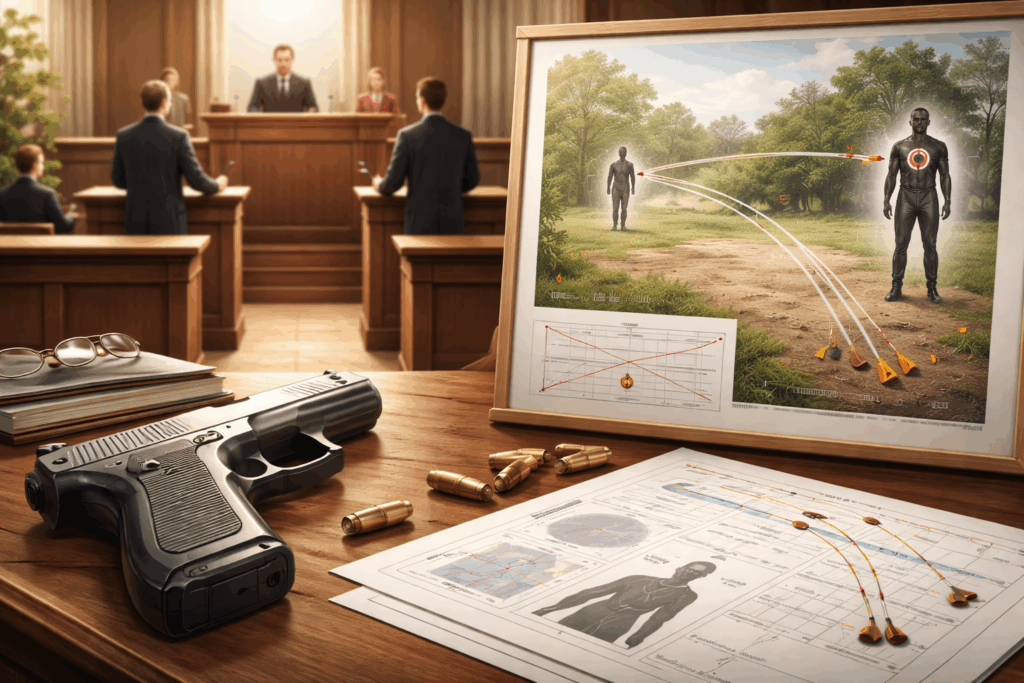
In criminal cases involving firearms, one of the most critical legal questions is whether the act constitutes a warning shot or attempted murder. This distinction directly affects criminal liability, sentencing severity, and the overall legal strategy in defending or prosecuting firearm-related offenses.
Courts do not decide this issue based on the defendant’s explanation alone. Even when an accused person claims, “I only fired a warning shot,” the court must independently assess whether the facts and evidence support that claim. In practice, determining warning shot vs attempted murder requires a careful legal analysis of intent, conduct, and objective forensic evidence—most notably, bullet trajectory.
This article explains how courts analyze firearm cases, the legal principles governing intent, and why physical evidence often outweighs verbal testimony. The discussion is intended for legal professionals, clients, and readers seeking a deeper understanding of criminal law standards applied in firearm cases.
Understanding Criminal Intent in Firearm Cases
The Legal Concept of Intent in Criminal Law
In criminal law, intent refers to the mental state of the accused at the time of the act. It answers the question of what the accused meant to achieve through their actions.
In firearm-related cases, courts must determine whether the shooter intended:
-
To kill,
-
To cause serious bodily harm, or
-
Merely to intimidate, deter, or protect themselves.
This distinction is essential because attempted murder requires a proven intent to kill, whereas a warning shot typically reflects a different mental state, often linked to intimidation or self-defense rather than lethal intent.
Why Intent Cannot Be Proven by Words Alone
Intent exists internally and cannot be observed directly. For this reason, courts consistently hold that a defendant’s statement about their own intent is not conclusive.
A claim such as:
“I did not intend to kill anyone”
must be evaluated against objective circumstances, including:
-
The manner of weapon use,
-
The sequence of events,
-
The presence or absence of provocation,
-
The direction in which the firearm was discharged.
As a result, courts rely heavily on external indicators rather than subjective explanations.
Warning Shot vs Attempted Murder: Legal Definitions
What Is a Warning Shot?
A warning shot generally refers to the discharge of a firearm intended to:
-
Deter an approaching threat,
-
Scare or intimidate,
-
Prevent further aggression without aiming to kill.
Legally, a warning shot may still be unlawful depending on jurisdiction, but it does not automatically imply an intent to kill. Courts will examine whether the shot was fired in a manner consistent with deterrence rather than lethal force.
What Constitutes Attempted Murder?
Attempted murder requires two essential legal elements:
-
A clear intent to kill, and
-
An act that directly moves toward the commission of that killing, even if death does not occur.
In firearm cases, aiming and firing at a vital part of the body often serves as strong evidence of such intent.
The difference between warning shot vs attempted murder therefore lies primarily in the inferred intention behind the act, rather than the mere use of a gun.
Why Bullet Trajectory Is Crucial Evidence
Bullet Trajectory as Objective Proof
Among all types of evidence, bullet trajectory is often considered the most reliable indicator of intent. Unlike witness testimony, physical evidence does not suffer from memory distortion, emotional bias, or deliberate falsehood.
Bullet trajectory analysis examines:
-
The angle of fire,
-
The direction of the bullet,
-
The point of impact,
-
The relationship between shooter and target.
This evidence allows courts to reconstruct what most likely occurred at the moment the firearm was discharged.
When Testimony Conflicts with Physical Evidence
In many firearm cases, prosecution witnesses may claim that:
“The defendant aimed directly at the victim.”
However, if forensic examination shows that:
-
The bullet struck the ground,
-
Hit a wall far from the alleged target,
-
Traveled upward into trees or open space,
then the physical facts contradict the testimony.
Courts consistently rule that when testimony conflicts with bullet trajectory, the credibility of the witness is significantly weakened.
In legal reasoning, physical evidence is often described as a “silent but decisive witness.”
Judicial Reasoning in Supreme Court Decisions
Evaluating Conduct Before the Shot Was Fired
In Supreme Court jurisprudence, courts emphasize examining the entire sequence of events, not just the moment the trigger was pulled.
Key questions include:
-
Did the defendant attempt to retreat?
-
Were verbal warnings issued?
-
Was the defendant surrounded or threatened?
-
Did the defendant have a reasonable opportunity to avoid using the firearm?
Conduct demonstrating restraint or avoidance often weighs against a finding of intent to kill.
Case Illustration: Retreat and Distance Matter
In a notable Supreme Court decision, the defendant was confronted by multiple armed individuals in a hostile situation. The defendant raised a firearm and verbally warned the group not to approach.
Importantly:
-
The defendant continued to retreat,
-
Increased distance to approximately 30 meters,
-
Fired only after creating space between himself and the threat.
The court reasoned that if the defendant intended to kill, he could have fired earlier at a closer range. The fact that he retreated and fired from a distance supported the conclusion that the shot was defensive rather than lethal.
Target Area and Intent to Kill
Why Vital Organs Matter in Legal Analysis
Courts give particular attention to where the bullet was directed. Aiming at:
-
The head,
-
The chest,
-
The heart or upper torso,
is commonly associated with an intent to kill, as these areas are widely recognized as vital and life-threatening targets.
Conversely, firing:
-
Into the ground,
-
Away from any person,
-
At non-vital areas,
tends to support a conclusion that the shooter did not intend to cause death.
The Legal Weight of Shooting Direction
Even if a firearm is discharged during a heated confrontation, courts distinguish between:
-
Using a gun as a deterrent, and
-
Using a gun as a killing instrument.
The direction of the shot often serves as the clearest dividing line between these two uses.
Self-Defense and Warning Shots
Relationship Between Warning Shots and Self-Defense Claims
A warning shot is frequently raised in the context of self-defense. While self-defense laws vary, courts typically assess whether:
-
The threat was imminent,
-
The response was proportionate,
-
Deadly force was necessary under the circumstances.
A warning shot may suggest an attempt to avoid deadly force, but it does not automatically justify the act. Courts still examine whether firing the gun was reasonable and necessary.
When a Warning Shot Does Not Excuse Liability
It is important to note that firing a warning shot can still result in criminal liability if:
-
There was no imminent threat,
-
The act endangered bystanders,
-
The force used was excessive.
Thus, while a warning shot may negate intent to kill, it does not guarantee immunity from prosecution.
Prosecutorial and Defense Perspectives
How Prosecutors Argue Attempted Murder
Prosecutors often focus on:
-
Weapon type and lethality,
-
Distance between shooter and target,
-
Alleged aiming behavior,
-
Prior disputes or motives.
Their objective is to show that the act went beyond intimidation and crossed into deliberate lethal conduct.
Defense Strategy in Warning Shot Cases
Defense counsel, by contrast, emphasizes:
-
Lack of targeting vital organs,
-
Defensive posture and retreat,
-
Absence of prior intent or motive,
-
Forensic inconsistencies in prosecution evidence.
A strong defense often hinges on technical forensic analysis rather than emotional narratives.
Practical Implications for Firearm Cases
Why Early Evidence Preservation Is Critical
In firearm cases, early preservation of:
-
Scene photographs,
-
Ballistic reports,
-
Trajectory analysis,
can be decisive. Delays or incomplete investigations may permanently undermine the ability to establish true intent.
Legal Advice for Individuals Involved in Firearm Incidents
Anyone involved in a firearm incident should understand that:
-
Statements made immediately after the event may be misinterpreted,
-
Physical evidence will likely outweigh verbal explanations,
-
Early legal representation is essential.
Understanding the legal distinction between warning shot vs attempted murder can significantly affect the outcome of a case.
Conclusion: The Legal Line Between Warning and Lethal Intent
In firearm-related criminal cases, the difference between a warning shot and attempted murder is determined not by what the shooter claims, but by what the evidence shows.
Courts assess:
-
The totality of circumstances,
-
The shooter’s conduct before and after firing,
-
Most importantly, the bullet trajectory.
These factors collectively allow courts to infer intent and impose appropriate legal consequences. For legal practitioners and the public alike, recognizing how intent is determined provides critical insight into the administration of criminal justice in firearm cases.