
Cross-Examination of Witness Credibility: Legal Principles and Practical Strategies in Criminal Litigation
Introduction
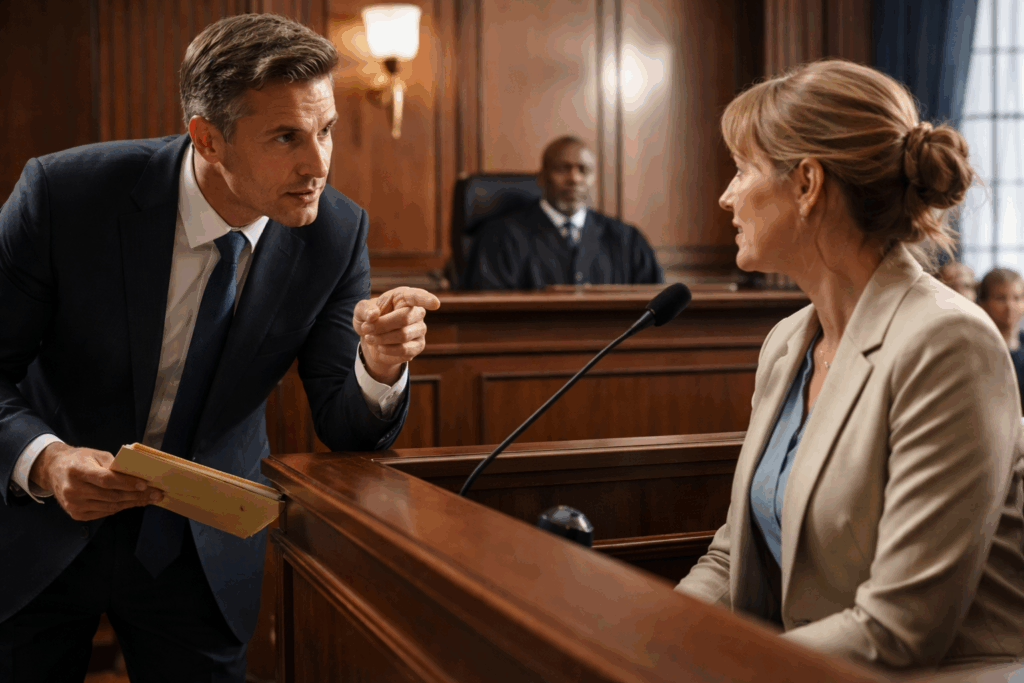
Cross-examination of witness credibility is one of the most critical tools in criminal litigation.
While direct examination aims to establish facts favorable to a party, cross-examination serves a fundamentally different function: it tests the reliability, accuracy, and impartiality of the opposing party’s witnesses.
In criminal proceedings, courts do not decide cases based solely on the number of witnesses presented, but on the credibility and probative value of their testimony. A single unreliable witness may be sufficient to undermine the prosecution’s case, while a credible witness may carry decisive weight.
This article provides a comprehensive legal analysis of the principles governing the cross-examination of witness credibility, with practical guidance suitable for trial lawyers, legal practitioners, and law firm clients seeking to understand how credibility is assessed in court.
The Legal Purpose of Cross-Examination
Cross-Examination Is Not About Proving the Defense Narrative
A common misconception is that cross-examination exists to prove that the defense’s version of events is true. In reality, its primary legal purpose is more restrained yet more powerful.
The true objective is to demonstrate to the court that:
The opposing witness is not sufficiently reliable to be relied upon in adjudicating the case.
A witness does not need to be proven dishonest. It is often enough to show that the witness:
-
Perceived the events incompletely
-
Remembered them inaccurately
-
Misinterpreted what was observed
-
Or testified under bias or influence
Once credibility is weakened, the court may lawfully disregard or give little weight to that testimony.
Judicial Assessment of Witness Credibility
How Courts Evaluate Witness Testimony
Courts generally assess witness credibility based on multiple interrelated factors, including:
-
The witness’s opportunity to observe the event
-
The clarity and consistency of the testimony
-
The witness’s demeanor and responsiveness
-
External corroboration or contradiction
-
Possible motives or interests affecting testimony
Cross-examination is the procedural mechanism through which these weaknesses are exposed.
Core Framework for Attacking Witness Credibility
From a litigation perspective, cross-examination of witness credibility can be structured around four principal pillars:
-
Ability to perceive the event
-
Ability to remember the event
-
Environmental and situational conditions
-
Impartiality and honesty of the witness
Each pillar is explored in detail below.
I. Ability to Perceive the Event
Distinguishing Presence from Perception
The mere presence of a witness at or near the scene does not establish that the witness actually perceived the relevant events.
Cross-examination must clarify whether the witness truly observed the incident or was simply nearby while engaged in other activities.
Key Areas of Inquiry
-
What the witness was doing at the time
-
Whether attention was focused elsewhere
-
Whether the witness was distracted by devices or conversation
-
Whether the witness was facing the direction of the event
If attention was divided, perception is necessarily limited.
Divided Attention and Human Perception
Modern judicial reasoning recognizes that human perception is selective. When a person is multitasking—such as using a mobile phone or speaking with others—visual and auditory processing deteriorates significantly.
A witness who was distracted cannot be assumed to have perceived events with precision.
II. Duration and Continuity of Observation
When Did the Witness Begin Observing?
Courts must know whether a witness observed:
-
The entire incident from the outset
-
Only a portion of the event
-
Or merely its conclusion
A witness who arrived mid-incident lacks contextual understanding of preceding actions.
The Impact of Short Observation Periods
Brief exposure to an event increases the likelihood of:
-
Misinterpretation
-
Assumption rather than observation
-
Memory reconstruction after the fact
Cross-examination should emphasize that shorter observation equals reduced reliability.
III. Psychological Condition at the Time of Observation
Stress, Fear, and Cognitive Distortion
The psychological state of a witness profoundly affects both perception and memory formation.
Relevant conditions include:
-
Fear or panic
-
Shock or surprise
-
Threats or intimidation
-
Emotional distress
Under stress, the brain prioritizes survival over detail, leading to fragmented or distorted recollection.
Legal Recognition of Stress Effects
Courts commonly accept that testimony given by a frightened or shocked witness must be evaluated with caution. Cross-examination should therefore establish the emotional state of the witness at the relevant time.
IV. Physical Condition and Age of the Witness
Children as Witnesses
Children may lack the cognitive maturity to:
-
Accurately sequence events
-
Distinguish imagination from observation
-
Resist suggestion
Their testimony is not inadmissible, but its weight is inherently limited.
Elderly and Medically Compromised Witnesses
Age-related memory decline, illness, fatigue, or medication can impair concentration and recall.
Cross-examination should explore:
-
Age-related memory issues
-
Health conditions affecting cognition
-
Use of medication influencing alertness
V. Vision and Hearing Capacity
Sensory Accuracy as a Foundation of Testimony
Witness testimony is fundamentally dependent on the accuracy of sensory perception.
Relevant questions include whether the witness:
-
Has visual impairments
-
Requires corrective lenses
-
Was wearing such lenses at the time
-
Has hearing difficulties
-
Was using earphones or headphones
If sensory input was compromised, testimonial accuracy must be questioned.
Illusion Versus Observation
What a witness believes was seen or heard may differ substantially from what objectively occurred, especially under imperfect sensory conditions.
VI. Position, Distance, and Angle of View
Spatial Relationship to the Event
Cross-examination must clarify:
-
The exact position of the witness
-
Distance from the incident
-
Height, angle, and orientation
-
Presence of physical obstructions
Distance and obstruction significantly reduce detail recognition.
Angle of View and Misinterpretation
Events viewed from indirect or obstructed angles are more susceptible to misinterpretation, particularly when movements are rapid or overlapping.
VII. Lighting and Environmental Conditions
Daylight Versus Artificial Light
Lighting conditions affect color perception, facial recognition, and motion detection.
Key factors include:
-
Time of day
-
Adequacy of lighting sources
-
Shadows or glare
-
Weather conditions
Poor lighting increases the risk of error.
VIII. Noise, Chaos, and Crowd Dynamics
Cognitive Overload in Chaotic Environments
In environments characterized by:
-
Loud noise
-
Multiple actors
-
Confusion or panic
the brain struggles to isolate individual actions or statements.
Cross-examination should highlight the difficulty of accurate perception under such circumstances.
IX. Direct Observation Versus Hearsay Contamination
Mixing Observation with Information from Others
Witnesses often unconsciously blend personal observation with information obtained from:
-
Other witnesses
-
Law enforcement officers
-
Media reports
This phenomenon creates sincere but inaccurate testimony.
Identifying Memory Reconstruction
Effective cross-examination distinguishes what the witness personally observed from what was learned afterward.
X. Coaching, Suggestion, and Preparation
Independence of Testimony
Witness credibility depends on independence.
Relevant inquiries include:
-
Who spoke to the witness before testimony
-
Whether statements were rehearsed
-
Whether leading suggestions were provided
Prepared testimony may reflect guidance rather than recollection.
XI. Bias, Interest, and Motive
Identifying Partiality
Courts must consider whether the witness is:
-
A relative or close associate
-
An employee or subordinate
-
A person with shared interests
-
A person with prior conflict with the accused
Bias does not invalidate testimony but reduces its objectivity.
Financial and Legal Incentives
Any benefit—direct or indirect—affecting the witness’s position must be disclosed and examined.
Ethical Limits of Cross-Examination
Professional Responsibility
Cross-examination must remain within ethical boundaries. Intimidation, harassment, or misrepresentation undermines the integrity of the proceedings and the credibility of counsel.
Effective cross-examination relies on precision, restraint, and logic, not aggression.
Strategic Considerations for Defense Counsel
Selecting the Right Battles
Not every inconsistency deserves emphasis. Skilled advocates focus on weaknesses that materially affect credibility.
Maintaining Narrative Control
Cross-examination should advance a coherent theme: the unreliability of the testimony, not the character of the witness.
Conclusion
Cross-examination of witness credibility is a cornerstone of criminal litigation. It does not require proving that a witness is dishonest. Rather, it requires demonstrating that the testimony is unreliable due to limitations in perception, memory, environment, or impartiality.
When credibility is reasonably questioned, courts are justified in declining to rely on such testimony as a decisive basis for judgment.
For law firms and criminal defense practitioners, mastering these principles is essential to protecting the rights of the accused and ensuring the integrity of the judicial process.