
Arrest Warrant in Thailand: How Arrest Warrants Are Issued Under Thai Criminal Procedure
Introduction: Understanding Arrest Warrants in Thailand
An arrest warrant in Thailand is one of the most powerful legal instruments in criminal procedure. It authorizes law enforcement officers to deprive an individual of liberty and bring that person into the criminal justice system. Despite its serious consequences, many people misunderstand how arrest warrants are issued, often believing that the police may arbitrarily obtain one at will.
This assumption is legally incorrect.
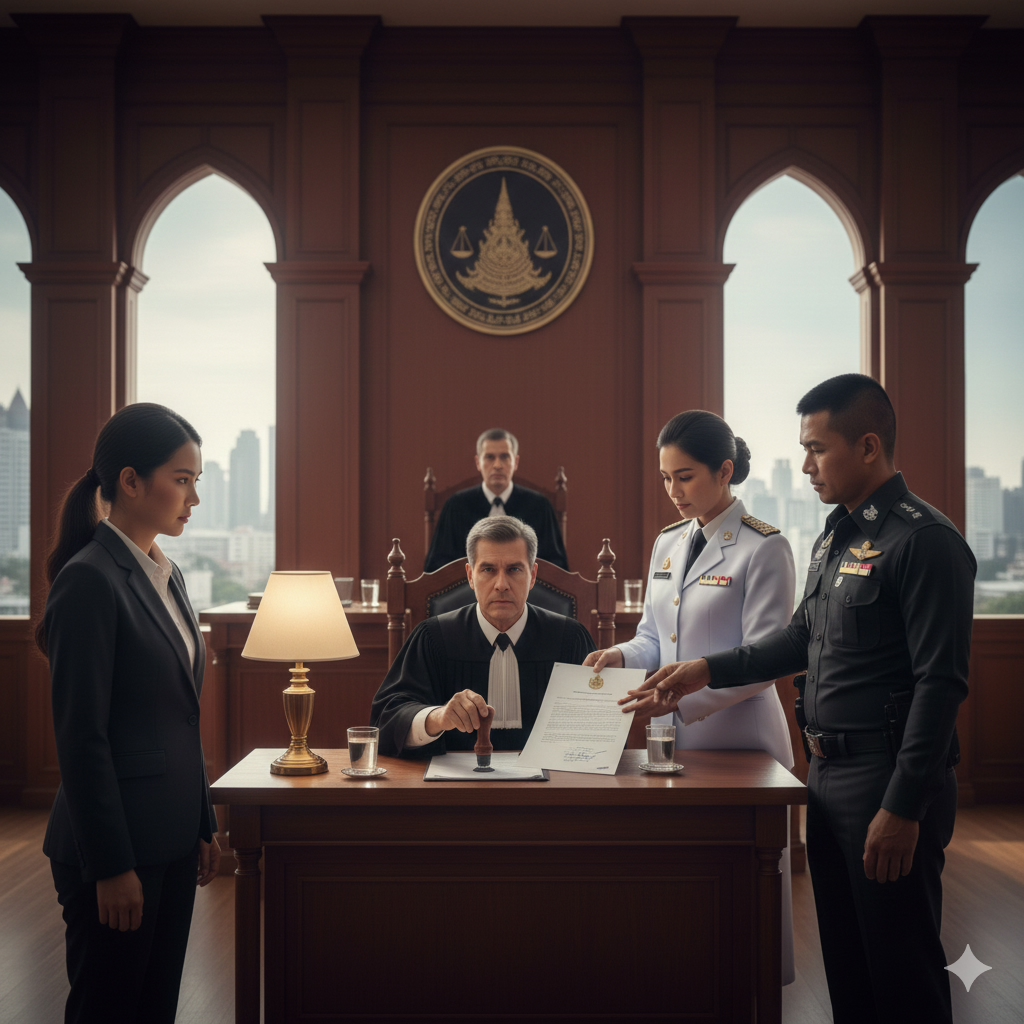
Under Thai law, only the court has the authority to issue an arrest warrant. The police or administrative officers may request one, but they do not have the power to issue it themselves. The requirement of judicial approval serves as a fundamental safeguard against abuse of power and is a cornerstone of due process under the Thai criminal justice system.
This article provides a comprehensive legal analysis of how arrest warrants are issued in Thailand, who may request them, the legal standards applied by the courts, and what individuals should understand if an arrest warrant has been issued against them.
Legal Basis of Arrest Warrants Under Thai Law
Arrest Warrants as a Judicial Control Mechanism
Thai criminal procedure is governed primarily by the Criminal Procedure Code of Thailand. The issuance of an arrest warrant is designed as a judicial checkpoint to balance two competing interests:
-
The state’s interest in enforcing criminal law and maintaining public order
-
The individual’s fundamental right to liberty and due process
Historically, Thai law allowed law enforcement officers to issue arrest warrants independently. However, this practice led to documented abuses, including politically motivated arrests and improper detention. As a result, the law was reformed to ensure that judicial scrutiny precedes any deprivation of liberty, except in narrowly defined urgent circumstances.
Today, the issuance of an arrest warrant in Thailand is strictly a court function.
Who Has the Authority to Request an Arrest Warrant?
Eligible Officials Under Thai Law
Not every government official may request an arrest warrant. Thai law limits this authority to specific officers, including:
-
Police investigators of a legally prescribed rank (generally from Sub-Lieutenant upward)
-
Senior administrative officers such as district chiefs or designated officials under special laws
Crucially, the officer requesting the arrest warrant must be directly responsible for the investigation of that specific case. A warrant request cannot be delegated to unrelated officers or made for convenience.
This requirement ensures accountability and prevents forum shopping or arbitrary warrant applications.
The Court’s Exclusive Authority to Issue Arrest Warrants
Why Police Cannot Issue Arrest Warrants Themselves
In Thailand, no arrest warrant is valid unless issued by a court. Even in serious criminal cases, police officers must submit a formal application supported by evidence and sworn testimony.
The court functions as an independent arbiter, assessing whether the legal requirements are met before authorizing an arrest. This separation of powers is essential to preserving the rule of law.
Legal Standards for Issuing an Arrest Warrant in Thailand
Overview of Section 66 of the Criminal Procedure Code
The primary legal framework governing arrest warrants is found in Section 66 of the Criminal Procedure Code. Under this provision, the court may issue an arrest warrant only when legally prescribed conditions are satisfied.
These conditions can be categorized into three principal scenarios.
Arrest Warrants in Serious Criminal Offenses (Penalty Exceeding Three Years)
Evidentiary Threshold for Serious Crimes
When a criminal offense carries a maximum imprisonment of more than three years, the court applies a distinct legal standard.
If the court finds reasonable grounds and sufficient preliminary evidence suggesting that the suspect likely committed the offense, it may issue an arrest warrant without requiring proof of flight risk or interference with evidence.
The rationale is that serious crimes inherently pose a higher risk to public safety and judicial integrity.
Practical Implications
Examples of such offenses include:
-
Serious fraud
-
Robbery
-
Drug trafficking
-
Sexual offenses
-
Certain corruption-related crimes
In these cases, the existence of credible evidence alone may justify an arrest warrant in Thailand.
Arrest Warrants in Minor Offenses With Aggravating Circumstances
Offenses With Penalties Not Exceeding Three Years
For offenses punishable by imprisonment of three years or less, Thai law adopts a more protective approach.
An arrest warrant may only be issued if there are specific aggravating circumstances, such as:
-
A reasonable belief that the suspect will flee
-
Evidence of intimidation or threats toward witnesses
-
Attempts to destroy or conceal evidence
Without such circumstances, arrest warrants should not be issued lightly in minor cases.
Legal Example
Defamation is generally a minor offense under Thai law. However, if a suspect engages in witness intimidation or evidence tampering, the court may find sufficient grounds to issue an arrest warrant despite the relatively low statutory penalty.
Failure to Appear After a Summons
Arrest Warrants Following Non-Compliance
Another key ground for issuing an arrest warrant in Thailand arises when an individual:
-
Fails to appear after receiving a lawful summons from investigators or the court
-
Has no fixed or verifiable address
In such situations, the law permits the court to presume an intention to evade justice.
This presumption allows the court to issue an arrest warrant even if the underlying offense is minor.
Is a Summons Required Before an Arrest Warrant?
General Rule and Legal Exceptions
Contrary to popular belief, Thai law does not require a summons in every case before an arrest warrant may be issued.
-
In serious offenses (over three years): no summons required
-
In minor offenses with aggravating behavior: no summons required
-
In minor offenses without risk factors: a summons must generally be issued first
This framework reflects a proportional approach to criminal enforcement.
Step-by-Step Procedure for Requesting an Arrest Warrant
1. Collection of Evidence
The investigator must gather documentary, testimonial, and physical evidence sufficient to establish reasonable suspicion.
2. Preparation of a Formal Application
The arrest warrant application must clearly state:
-
The alleged offense
-
Relevant facts and evidence
-
Legal grounds for requesting the warrant
3. Sworn Testimony Before the Court
The investigator must appear before the court and swear an oath affirming the truthfulness of the application.
False statements may expose the officer to criminal and disciplinary liability.
4. Judicial Examination
The court may question the applicant, review evidence, and assess whether statutory requirements are met.
5. Court Order
The court will either:
-
Grant the arrest warrant, or
-
Reject the application with reasons
Judicial reasoning is mandatory in both outcomes.
Arrest Warrants Are Not Automatically Granted
Judicial Discretion and Oversight
Courts in Thailand routinely reject arrest warrant applications that lack sufficient evidence or legal justification. This reinforces the principle that arrest warrants are not administrative formalities, but judicial decisions grounded in law.
Legal Consequences of an Issued Arrest Warrant
What an Arrest Warrant Signifies
An arrest warrant in Thailand indicates that the court has found:
-
Credible evidence linking the suspect to the offense
-
Legal necessity to compel appearance or prevent harm to the judicial process
It does not mean that the individual is guilty.
Rights of Individuals Named in an Arrest Warrant
Presumption of Innocence
All suspects remain legally innocent until proven guilty by a final court judgment.
Right to Legal Counsel
Individuals have the right to consult and be represented by a lawyer immediately upon arrest.
Right to Apply for Bail
In most cases, bail may be requested at the earliest procedural stage, including during police custody or court proceedings.
Why Evading Arrest Worsens Legal Outcomes
Legal and Practical Risks of Flight
Attempting to evade arrest may result in:
-
Additional criminal charges
-
Denial of bail
-
Harsher judicial perception
Entering the legal process with proper representation is almost always the preferable course of action.
Arrest Warrants as a Safeguard, Not a Weapon
Protecting the Rule of Law
The arrest warrant system in Thailand is designed to protect citizens from arbitrary detention while enabling lawful criminal enforcement.
The requirement of court approval, sworn testimony, and judicial reasoning collectively ensures that arrest warrants function as a shield for rights, not a tool of harassment.
Conclusion: Arrest Warrants in Thailand Explained
An arrest warrant in Thailand is not issued at the discretion of the police. It is the result of a structured legal process requiring judicial oversight, evidentiary support, and statutory compliance.
In summary:
-
Police may request arrest warrants, but only courts may issue them
-
Legal thresholds vary depending on the seriousness of the offense
-
Judicial scrutiny is mandatory at every stage
Understanding this process is essential for protecting legal rights and navigating Thailand’s criminal justice system effectively.